
Fire safety is one of the most critical aspects of protecting lives, property, and business operations. Whether you’re a homeowner, a facility manager, or a business owner, understanding the different types of fire suppression systems available can help you make the right choice for your building’s needs. At Advanced Times Company, we provide expert guidance and professional installation of fire suppression systems tailored to every environment.
What Are Fire Suppression Systems?
Fire suppression systems are active fire protection methods designed to detect, control, and extinguish fires automatically or manually before they cause extensive damage. Unlike fire detection systems (such as smoke alarms), fire suppression systems go a step further by actively fighting the fire. They are installed in residential, commercial, industrial, and specialized facilities to minimize risk and comply with safety regulations.
Choosing the right fire suppression system depends on several factors, including the type of building, the nature of the hazard, the materials present, and applicable fire codes.
1. Water-Based Fire Suppression Systems
Water-based systems are the most widely used fire suppression systems across the globe. They are cost-effective, reliable, and suitable for a wide range of environments.
Wet Pipe Sprinkler Systems
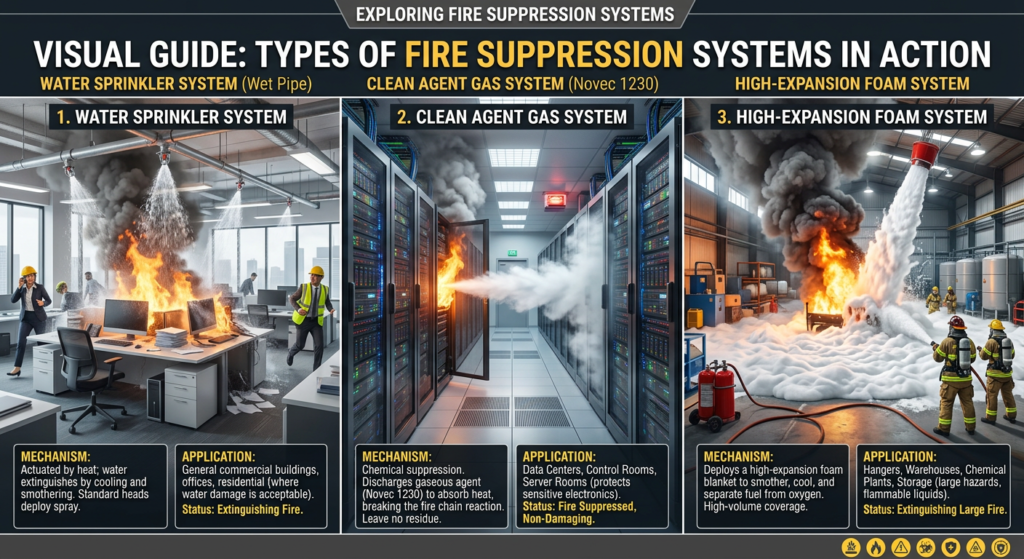
Wet pipe systems are the most common type of sprinkler system. Water is stored under pressure in the pipes at all times, ready to discharge immediately when a sprinkler head is activated by heat. These systems are ideal for offices, hotels, retail spaces, and residential buildings where freezing temperatures are not a concern.
Advantages:
- Simple design and low maintenance
- Fast response time
- Highly cost-effective
Dry Pipe Sprinkler Systems
In dry pipe systems, the pipes are filled with pressurized air or nitrogen instead of water. When a sprinkler activates, the air pressure drops, allowing water to flow. These systems are perfect for areas prone to freezing temperatures, such as parking garages, warehouses, and unheated storage facilities.
Pre-Action Sprinkler Systems
Pre-action systems require two separate triggers before water is discharged — a fire detection system must first activate, and then a sprinkler head must open. This two-step process prevents accidental water discharge, making it ideal for data centers, museums, libraries, and areas housing sensitive equipment or irreplaceable items.
Deluge Systems
Deluge systems have open sprinkler heads and are connected to a water supply through a deluge valve. When the system activates, water discharges simultaneously from all open heads. These systems are used in high-hazard areas such as aircraft hangars, chemical plants, and power generation facilities where rapid fire spread is a concern.
2. Gaseous Fire Suppression Systems
Gaseous fire suppression systems are used in environments where water damage would be catastrophic or where water-based systems are ineffective. They work by either displacing oxygen or chemically interrupting the combustion process.
CO₂ (Carbon Dioxide) Systems
Carbon dioxide systems suppress fire by reducing oxygen levels in the protected area. Because CO₂ leaves no residue, they are ideal for protecting machinery, electrical equipment, and industrial processes. However, CO₂ is dangerous to humans at suppression concentrations, so these systems are typically used in unoccupied or easily evacuated spaces.
Clean Agent Systems
Clean agent systems use chemical compounds — such as FM-200 (HFC-227ea), Novec 1230, or INERGEN — that suppress fires without leaving any residue and are safe for use in occupied spaces. These systems are widely used in:
- Server rooms and data centers
- Telecommunications facilities
- Control rooms and archives
- Museums and art galleries
Clean agent systems work by absorbing heat from the fire or chemically interrupting the chain reaction of combustion. They are environmentally compliant, safe for electronics, and discharge in seconds.
Inert Gas Systems
Inert gas systems (using gases like argon, nitrogen, or a blend of both) work by reducing the oxygen concentration in a room to a level where fire cannot sustain itself, while remaining safe for human occupancy. These are a popular choice for heritage sites and environmentally sensitive installations.
3. Foam Fire Suppression Systems
Foam-based fire suppression systems are primarily used to combat flammable liquid fires (Class B fires) in industries such as oil and gas, aviation, and petrochemicals.
How Foam Systems Work
Foam agents are mixed with water to create a blanket that coats burning fuel, cutting off its oxygen supply and preventing re-ignition. There are several types of foam agents, including:
- AFFF (Aqueous Film-Forming Foam) – Fast-spreading foam for hydrocarbon fires
- AR-AFFF (Alcohol-Resistant AFFF) – Used for alcohol and polar solvent fires
- High-Expansion Foam – For three-dimensional fires in enclosed spaces such as basements or aircraft hangars
Foam systems can be applied through fixed nozzles, monitor nozzles, or portable equipment, depending on the facility’s needs.
4. Dry Chemical Fire Suppression Systems
Dry chemical systems discharge a fine powder to interrupt the chemical chain reaction of a fire. They are extremely fast and effective across multiple fire classes (A, B, and C), making them versatile for commercial kitchens, industrial facilities, and vehicle fire protection.
Types of Dry Chemical Agents
- Monoammonium Phosphate (MAP) – Multi-purpose agent effective on Class A, B, and C fires
- Sodium Bicarbonate – Best for Class B and C fires (flammable liquids and electrical fires)
- Potassium Bicarbonate (Purple K) – Highly effective on Class B fires
Note: Dry chemical systems can cause significant cleanup after discharge and may damage sensitive equipment, so they are not suitable for all environments.
5. Wet Chemical Fire Suppression Systems
Wet chemical systems are specifically designed for commercial cooking environments. They use a potassium-based liquid agent that reacts with cooking oils and fats to form a soap-like layer (a process called saponification), smothering the fire and preventing re-ignition.
These systems are mandatory in most commercial kitchens, restaurants, and cafeterias under current fire safety codes. They are typically installed over cooking equipment such as deep fryers, grills, and ranges, and are connected to the kitchen ventilation hood.
6. Water Mist Fire Suppression Systems
Water mist systems discharge very fine droplets of water at high pressure, which evaporate quickly and cool the fire while displacing oxygen. They use significantly less water than traditional sprinkler systems, making them ideal for:
- Hotels and healthcare facilities
- Historic buildings and heritage sites
- Marine and offshore environments
- Areas where water damage is a major concern
Water mist systems are increasingly popular because they combine the effectiveness of water with the reduced collateral damage advantages of gaseous systems.
7. Condensed Aerosol Fire Suppression Systems
Condensed aerosol systems are a newer technology that generates a fine aerosol of potassium compounds to suppress fires. They are compact, have a long service life, and require no pressure vessels or pipework, making them suitable for:
- Electrical cabinets and enclosures
- Marine engine rooms
- Transportation vehicles
- Remote or hard-to-access areas
Aerosol systems are gaining recognition as an environmentally friendly and cost-effective alternative for small enclosed spaces.
8. Specialized Fire Suppression Systems
Kitchen Hood Suppression Systems
Beyond wet chemical systems, specialized kitchen hood suppression systems are integrated into commercial cooking exhaust hoods. They automatically activate in response to heat or flame, protecting not just the cooking surface but the entire exhaust path.
Vehicle and Machinery Fire Suppression Systems
Mobile fire suppression systems are installed in heavy-duty vehicles, mining equipment, and construction machinery. These systems use dry chemical or liquid agents to protect operator cabins, engine compartments, and hydraulic systems from fire.
Industrial and High-Hazard Systems
For facilities with unique fire risks — such as paint spray booths, semiconductor manufacturing, or explosive storage — customized fire suppression solutions integrate detection, control panels, and discharge systems engineered specifically for the hazard profile.
How to Choose the Right Fire Suppression System
Selecting the most appropriate fire suppression system for your property requires careful consideration of the following factors:
- Type of occupancy – Residential, commercial, industrial, or specialized
- Nature of the fire risk – Class A (ordinary combustibles), Class B (flammable liquids), Class C (electrical), Class K (cooking oils)
- Sensitivity of contents – Electronics, documents, artwork, and other valuables may require clean agent or water mist systems
- Local fire codes and regulations – Compliance with NFPA, local authority requirements, and insurance mandates
- Budget and maintenance costs – Initial installation, inspection, testing, and agent replacement costs
- Environmental considerations – Some agents are being phased out due to environmental impact
Working with a certified fire protection professional ensures that your system is properly designed, installed, and maintained for maximum effectiveness.
Why Professional Installation Matters
A fire suppression system is only as effective as its installation and maintenance. Improper design, poor-quality components, or inadequate maintenance can result in system failure during a critical moment. At Advanced Times Company, our certified technicians assess your specific environment, recommend the most suitable system, and ensure full compliance with applicable standards.
We provide comprehensive services including:
- Site assessment and hazard analysis
- System design and engineering
- Professional installation and commissioning
- Regular inspection, testing, and maintenance
- 24/7 emergency support
Conclusion
The right fire suppression system can mean the difference between a minor incident and a catastrophic loss. From traditional water sprinklers to advanced clean agent and aerosol systems, there is a solution designed for every type of building and hazard. Understanding the options available empowers you to make an informed decision that protects your people, your assets, and your operations.
To learn more about which fire suppression system is right for your needs, visit Advanced Times Company today and speak with one of our fire protection specialists. Your safety is our priority.
Advanced Times Company — Your trusted partner in comprehensive fire protection and life safety solutions.