 Skip to content
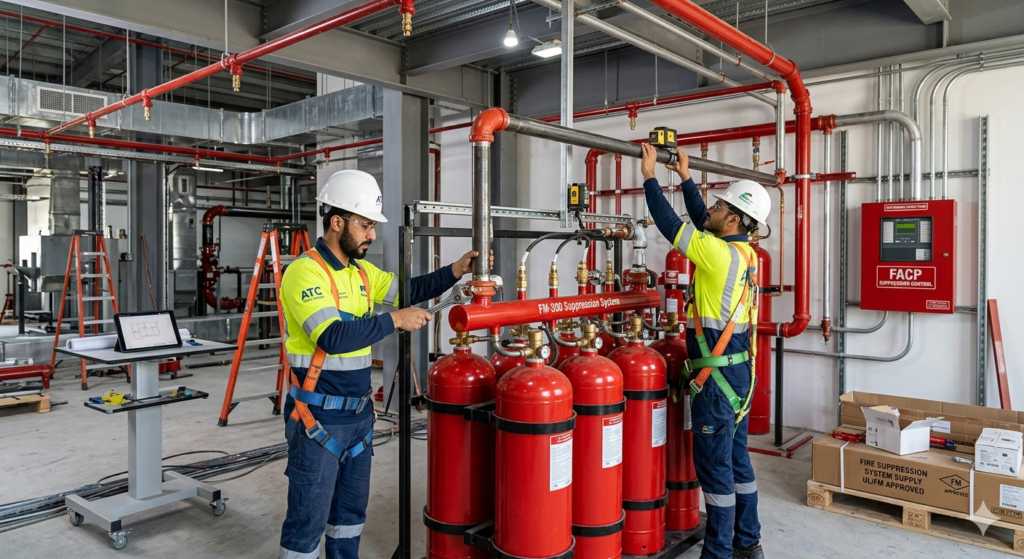
With Saudi Arabia’s industrial and urban landscape rapidly expanding under Vision 2030, safeguarding critical infrastructure is more vital than ever. For facility managers, developers, and contractors across the Kingdom, understanding the mechanics of a Fire Suppression System in Saudi Arabia isn’t just a matter of safety—it’s a strict regulatory and operational mandate.
This comprehensive guide breaks down the essential typologies, strict local compliance standards, and the end-to-end installation lifecycle required to protect high-value assets in KSA.
What is a Fire Suppression System?
Unlike standard fire sprinklers that primarily use water to contain a fire, a fire suppression system is engineered to detect, contain, and extinguish fires automatically using specialized chemical agents, inert gases, or high-expansion foam. These systems are critical for environments where water would cause catastrophic, irreversible damage to electrical equipment, data centers, or combustible hazardous materials.
1. The Regulatory Landscape: Saudi Civil Defense & HCIS Compliance
Deploying an active fire protection asset in the Kingdom requires strict alignment with local statutory frameworks. A system is only as good as its legal certification.
- Saudi Civil Defense (Al-Difa’a Al-Madani): The absolute governing authority for life safety codes in KSA. No commercial or industrial facility can receive or renew its operational license without a certified inspection, approved hydraulic calculation validation, and signed-off layouts.
- Saudi Building Code (SBC) 801: This specific framework dictates localized fire-related codes, active protection requirements, and structural material variables tailored to the Middle Eastern climate.
- High Commission for Industrial Security (HCIS): Mandated specifically for critical national infrastructure, oil & gas installations, and petrochemical plants. HCIS requires rigorous vendor pre-qualification, strict risk modeling, and redundant safety architectures.
- International Codes: Systems must simultaneously adhere to global benchmarks, including NFPA 13 (Sprinklers), NFPA 2001 (Clean Agents), and NFPA 20 (Fire Pumps), ensuring all components are UL Listed and FM Approved.
2. Core Fire Suppression Typologies Supplied in KSA
Clean Agent Fire Suppression Systems (Waterless Protection)
Perfect for data hubs, control rooms, and telecommunication centers where water clean-up would destroy delicate circuitry.
- FM-200 (HFC-227ea): A highly reliable, cost-effective chemical gas that extinguishes fires at a molecular level without leaving any corrosive residue.
- Novec 1230 (FK-5-1-12): A next-generation, eco-friendly clean agent boasting a Global Warming Potential (GWP) of 1. It is the premier choice for sustainable smart city developments across NEOM and the Red Sea project.
- Inert Gas Systems (Inergen / IG-55): Natural blended gases that safely lower oxygen thresholds to suppress fires while remaining completely safe for occupied spaces.
Water-Based & Foam Deployed Systems
- Pre-Action Sprinklers: Ideal for cleanrooms and high-value libraries; requires a dual-stage validation signal before water enters the overhead piping network, preventing accidental discharges.
- Deluge Systems: Deployed with open nozzles in extreme-hazard areas like aircraft hangars and fuel storage bays to instantly flood a massive footprint.
- High-Expansion Foam: Engineered to rapidly engulf massive volumetric spaces such as chemical processing plants and massive logistics hubs.
3. The Supply & Installation Lifecycle
A turn-key approach to Fire Suppression System Installation in KSA involves a highly technical, four-phase execution timeline:
| Project Phase | Core Engineering Focus | Critical Deliverables |
| Phase 1: Survey & Design | Risk profiling, architectural blueprint analysis, and running professional hydraulic calculations using specialized software (HASS / Elite). | Full CAD/BIM coordinated layouts and detailed hazard classification reports. |
| Phase 2: Material Supply | Procuring components from elite global tier-1 manufacturers. | UL certificates, FM approvals, and Civil Defense local vendor authorization. |
| Phase 3: Physical Installation | Structural anchoring, high-pressure pipe routing, grooving/welding to ASME standards, and seamless integration into Centralized Fire Alarm Control Panels (FACP). | Hydrostatic pressure testing logs (e.g., 200 psi test for 2 hours) and mechanical integrity sign-offs. |
| Phase 4: Testing & Handover | Integrated loop testing, Room Integrity Fan Tests (for gas retention), and hosting official Civil Defense inspections. | Operational clearance sign-off, system commissioning certificates, and client team training. |
4. Overcoming KSA’s Environmental Challenges
Designing a fire suppression layout in Saudi Arabia requires accounting for intense environmental factors that can cause standard setups to degrade or fail prematurely:
- Thermal Management (>50°C Environments): Intense summer heat in regions like Riyadh, Yanbu, and the Eastern Province can trigger false pressure-relief valves on clean agent cylinders. Specialized thermal monitoring and insulated enclosures are required.
- Aggressive Marine Corrosion: Facilities in coastal industrial zones like Jeddah, Jubail, or Dammam face high humidity and airborne chemical particles. Using heavy-duty galvanized piping, anti-corrosive epoxy coatings, and SS316 stainless-steel brackets is mandatory to prevent pinhole leaks.
- Water Scarcity Dependencies: Due to KSA’s arid climate, municipal networks cannot be relied upon for emergency water volumes. Facilities must integrate independent, lined above-ground or underground water storage tanks calculated to sustain fire pump delivery for 30 to 120 minutes (per NFPA 22/24 codes).
Why Partner with Advanced Times Company (ATC)?
When protecting multi-million riyal assets, experience matters. Advanced Times Company (ATC) provides an uncompromised, turn-key engineering approach across the Kingdom. From initial hazard analysis and certified material procurement to final Civil Defense handover, our NFPA-trained engineers ensure your project meets every strict regulatory standard smoothly.
Secure your facility’s operational continuity today. Explore our robust fire engineering portfolio or schedule a professional technical consultation directly at Advanced Times Company