 Skip to content
Published by Advanced Times Company for General Contracting | Riyadh, KSA | advancedtimescompany.com
A fire does not announce itself. It starts silently — in a cable tray, behind a server rack, in an industrial control panel — and within minutes it can destroy equipment, shut down operations, and endanger lives. That is exactly why fire suppression systems are not optional extras in Saudi Arabia. They are critical infrastructure.
Whether you manage a commercial tower in Riyadh, a data center in Jeddah, a manufacturing facility in Dammam, or a hospital anywhere in the Kingdom, the right suppression system is the difference between a contained incident and a catastrophic loss. This guide explains how these systems work, what types are available, which environments need which solution, and what the regulatory requirements look like in KSA — so you can make an informed decision for your facility.
What Is a Fire Suppression System?
| A fire suppression system is an engineered, automatic fire protection solution that detects fire conditions and activates to control or extinguish the fire before it spreads. Unlike a fire alarm — which only alerts people — a suppression system physically fights the fire using a stored suppression agent released automatically through a distribution nozzle network. |
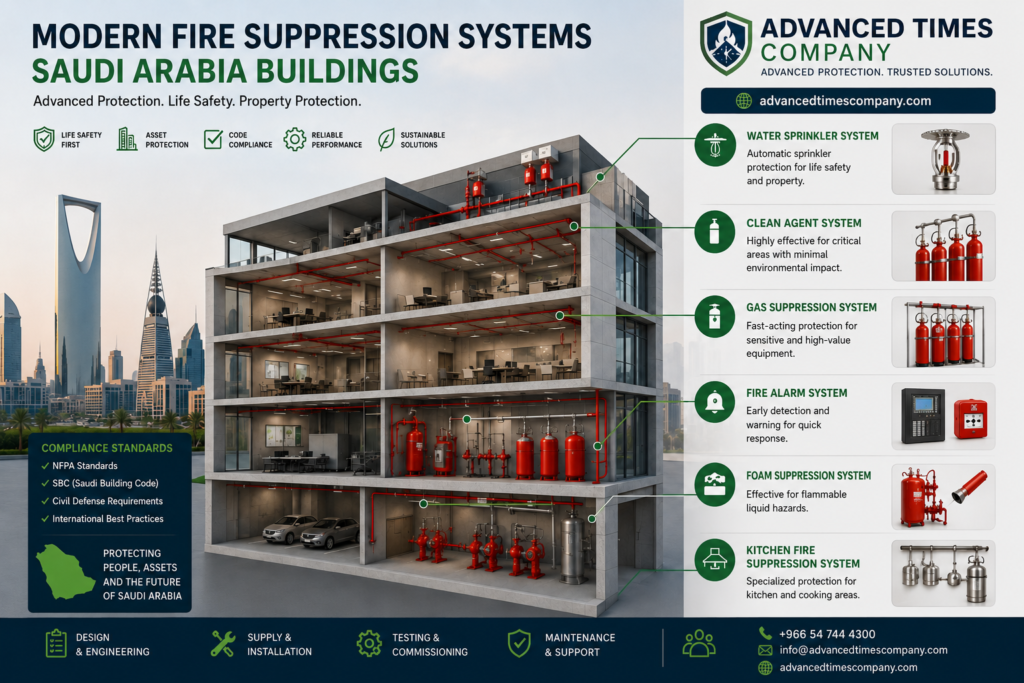
A typical automatic fire suppression system includes fire and smoke detectors, a control panel, pressurized agent storage cylinders, a distribution piping network, and discharge nozzles. When sensors detect heat, smoke, or a rapid temperature rise above a set threshold, the control panel triggers the release of the suppression agent through the nozzles — flooding the protected zone within seconds.
The agent used depends entirely on the application. Water-based sprinkler systems work well in warehouses and hotels. Clean-agent gas systems such as FM-200 and Novec 1230 protect data centers and server rooms without damaging equipment. CO2 systems are suited to unoccupied industrial spaces like turbine enclosures and generator rooms. Foam systems handle flammable liquid hazards in fuel storage areas and refineries.
Each system type has a specific engineering basis, a defined application range, and a set of international and local compliance standards that govern its design, installation, and maintenance.
Why Fire Suppression Systems Matter More in Saudi Arabia
Saudi Arabia’s built environment and industrial profile create a fire risk landscape that is genuinely unique. The combination of extreme ambient temperatures, large-scale petrochemical and oil and gas infrastructure, rapidly expanding commercial and hospitality sectors, and an increasing concentration of high-value data centers and telecom facilities means the consequences of fire incidents here are typically more severe — and the demand for protection is higher — than in most other markets.
The Kingdom has also undergone significant regulatory tightening. Saudi Civil Defense has enforced stricter requirements for fire protection systems across residential, commercial, and industrial projects as part of broader Vision 2030 infrastructure development standards. SASO regulations and NFPA-aligned standards now govern a wide range of facilities, and compliance is not simply a matter of paperwork — it directly affects operating licenses, insurance coverage, and liability.
Beyond regulation, the economics are straightforward. A fire incident in a data center can destroy millions of riyals worth of equipment in minutes. A fire in an oil refinery can trigger a chain reaction with consequences that extend far beyond the facility boundary. The cost of installing and maintaining a proper fire suppression system is a fraction of what any serious fire incident would cost in damage, downtime, legal exposure, and reputational harm.
Types of Fire Suppression Systems Used in Saudi Arabia
Choosing the right system starts with understanding what is available and where each type is most appropriate. Here is a clear breakdown of the main categories deployed across KSA.
FM-200 Gas Suppression Systems
FM-200 (also known as HFC-227ea) is one of the most widely installed clean-agent fire suppression systems in Saudi Arabia. It extinguishes fire by absorbing heat from the combustion process, effectively cutting off the fire’s energy source within seconds of activation. The discharge leaves no residue, causes no water damage, and is safe for occupied spaces at design concentrations.
FM-200 systems are the go-to choice for data centers, server rooms, control rooms, telecom facilities, and electrical switch rooms where equipment damage from water or other agents would be as devastating as the fire itself. The system can suppress a fire in under ten seconds — fast enough to protect sensitive electronics before heat causes irreversible damage.
Novec 1230 Clean Agent Systems
Novec 1230 (3M’s proprietary fluoroketone) offers similar suppression performance to FM-200 but with a significantly lower environmental impact. It has an atmospheric lifetime of just five days and a global warming potential near zero, making it the preferred choice for organizations with strong sustainability commitments or facilities covered by environmental compliance requirements.
In Saudi Arabia, Novec 1230 is increasingly used in hospitals, museums, archives, government buildings, and financial institutions — environments where irreplaceable assets or strict environmental policies drive specification choices. Its rapid evaporation after discharge means the protected area can often be returned to service quickly with minimal disruption.
CO2 Fire Suppression Systems
Carbon dioxide (CO2) suppression works by displacing oxygen in the protected zone, removing one of the three elements — fuel, heat, oxygen — that fire needs to sustain itself. CO2 systems are highly effective and leave absolutely no residue, but because they create an oxygen-deficient atmosphere, they are only suitable for unoccupied or evacuated spaces.
In Saudi Arabia’s industrial sector, CO2 systems protect turbine enclosures, generator rooms, power plant switch rooms, and manufacturing equipment areas. They are cost-effective for large industrial applications and particularly useful where other clean agents might not be practical due to scale or economics.
Water-Based Sprinkler Systems
Fire sprinkler systems remain the most widely installed type of fire suppression globally, and Saudi Arabia is no exception. These systems activate when a sprinkler head is exposed to heat above its activation threshold — typically between 57°C and 141°C — and release water directly onto the fire source.
Modern sprinkler systems are highly discriminate: only the heads nearest the heat source activate, not the entire system. This minimizes water damage while delivering effective suppression. Sprinkler systems protect hotels, shopping malls, office buildings, hospitals, warehouses, and residential towers across the Kingdom, and are typically mandated by Saudi Civil Defense regulations for buildings above a certain occupancy or height.
Foam Fire Suppression Systems
Foam suppression is specifically engineered for flammable liquid hazards — environments where water would spread the fire rather than suppress it. Foam creates a floating blanket over the fuel surface, cutting off oxygen and preventing re-ignition. These systems are essential in Saudi Arabia’s oil refineries, fuel storage terminals, aircraft hangars, chemical processing facilities, and tank farms.
Kitchen Fire Suppression Systems
Commercial kitchens generate grease-laden cooking fumes that create a specific class of fire risk. Kitchen suppression systems use wet chemical agents that react with cooking oils to form a soapy foam, rapidly cooling the fuel surface and preventing re-ignition. These systems are required in restaurant kitchens, hotel food and beverage facilities, food courts, and catering operations — all of which are expanding rapidly across Saudi Arabia’s growing hospitality and tourism sector.
Which Facilities Need Fire Suppression Systems in Saudi Arabia?
Saudi Civil Defense regulations and NFPA-aligned standards apply to a broad range of facility types. The table below provides a practical overview of which environments typically require which suppression approach:
| Facility Type | Recommended System |
| Data Centers / Server Rooms | FM-200 or Novec 1230 |
| Oil & Gas / Refineries | Foam + CO2 |
| Commercial Office Towers | Sprinkler + Clean Agent for IT rooms |
| Hospitals & Clinics | Novec 1230 + Sprinkler |
| Hotels & Hospitality | Sprinkler + Kitchen Suppression |
| Warehouses & Logistics | Sprinkler (in-rack where needed) |
| Manufacturing / Industrial | CO2 or Foam depending on hazard |
| Telecom Facilities | FM-200 or Novec 1230 |
| Government / Institutional | Novec 1230 + Sprinkler |
| Aircraft Hangars | Foam Deluge |
| Restaurants / Food Courts | Kitchen Wet Chemical Suppression |
Compliance Standards: What Applies in Saudi Arabia?
Fire suppression systems in Saudi Arabia must comply with a layered framework of local and international standards. Understanding this framework is essential for any facility owner or project manager involved in a new build or refurbishment.
Saudi Civil Defense (SCD) requirements are the primary local authority. Civil Defense approval is required for fire protection system designs before installation can proceed, and systems must be tested and commissioned to their satisfaction before a facility receives its operating certificate.
SASO (Saudi Standards, Metrology and Quality Organization) standards govern the quality and specification of fire protection equipment supplied in the Kingdom.
NFPA (National Fire Protection Association) standards form the technical backbone of most fire protection engineering in Saudi Arabia. The most commonly referenced include:
- NFPA 13 — Standard for the Installation of Sprinkler Systems
- NFPA 14 — Standard for the Installation of Standpipe and Hose Systems
- NFPA 20 — Standard for the Installation of Stationary Pumps for Fire Protection
- NFPA 72 — National Fire Alarm and Signaling Code
- NFPA 2001 — Standard on Clean Agent Fire Extinguishing Systems
Any credible fire suppression contractor in Saudi Arabia will design and install systems in full compliance with these standards, obtain the necessary Civil Defense approvals, and provide proper testing and commissioning documentation upon project completion.
The Fire Suppression System Installation Process
A professional installation is not simply a matter of fitting cylinders and running pipes. The process follows a structured engineering lifecycle that, when done correctly, ensures the system performs reliably when it is actually needed.
Step 1 — Site Survey and Risk Assessment
Every project starts with a thorough assessment of the facility — occupancy type, fire hazard classification, fire load, equipment sensitivity, environmental conditions, and spatial layout. This assessment drives every subsequent design decision.
Step 2 — System Design and Engineering
The engineering team develops system layouts, hydraulic calculations, agent quantity calculations, detector placement, nozzle coverage maps, and compliance documentation. Each design is specific to the facility — generic templates are not appropriate for suppression engineering.
Step 3 — Equipment Supply
Cylinders, control panels, detectors, nozzles, piping, valves, and monitoring devices are procured from approved manufacturers meeting international quality standards.
Step 4 — Professional Installation
Certified technicians carry out the physical installation — piping runs, cylinder mounting, electrical wiring, detector installation, control panel integration, and nozzle placement — following strict quality assurance procedures throughout.
Step 5 — Testing and Commissioning
Before handover, the complete system undergoes functional testing: detector tests, alarm verification, pressure testing, integration testing, and full system validation. Any issues identified during commissioning are resolved before the system is declared operational.
Step 6 — Ongoing Maintenance
Suppression systems require regular inspection and maintenance to remain effective. Annual certification, preventive inspections, system diagnostics, component replacement, and agent refilling services — including FM-200 gas refilling and Novec gas refilling — keep the system compliant and ready.
Common Mistakes Facility Owners Make with Fire Suppression Systems
Several recurring errors create real risk in Saudi Arabian facilities. Being aware of them helps you avoid them.
Selecting the Wrong System Type
Installing a water-based sprinkler system in a data center, or a CO2 system in an occupied space without proper evacuation protocols, are mistakes that can cause more damage than the fire itself. System selection must be driven by the specific hazard, not by cost minimization alone.
Skipping the Engineering Phase
Some projects try to shortcut the design process to save time or money. Undersized agent storage, inadequate nozzle coverage, and improper detector placement are the typical results — and none of them become apparent until the system fails to suppress a real fire.
Neglecting Maintenance
A suppression system that has not been inspected in two years may not function when activated. Agent cylinders lose pressure. Detectors develop faults. Valves can seize. Regular maintenance is not optional — it is the mechanism by which the investment remains functional.
Using Uncertified Contractors
In Saudi Arabia, fire protection contracting requires specific technical credentials and the ability to obtain Civil Defense approval. Using contractors without the necessary experience or compliance knowledge creates legal exposure and safety risk.
How to Choose a Fire Suppression Contractor in Saudi Arabia
When evaluating contractors, several criteria matter:
- Conducts a proper site survey before proposing any system
- Produces engineering drawings and hydraulic calculations — not just a quotation
- Has direct experience with Civil Defense approval processes in KSA
- References completed projects of similar scale and type to yours
- Provides clear testing, commissioning, and handover documentation
- Offers a defined maintenance and refilling program post-installation
Advanced Times Company for General Contracting provides complete fire suppression system services across Saudi Arabia — from the initial risk assessment and engineering design through to equipment supply, professional installation, testing, commissioning, and ongoing maintenance. Serving commercial, industrial, healthcare, hospitality, data center, and oil and gas sectors across Riyadh, Jeddah, Dammam, and the wider Kingdom, the company’s engineering team is experienced with the full range of suppression technologies and the local compliance requirements that apply to each.
Advanced Times also operates in strategic partnership with SLETEC — a global leader in engineering solutions for energy, petrochemical, and industrial sectors — bringing mega-project capability and international engineering standards to every fire protection engagement in the Kingdom.
Frequently Asked Questions
Q: What is the difference between a fire suppression system and a fire alarm system?
A: A fire alarm system detects fire and alerts building occupants. A fire suppression system goes further — it actively discharges a suppression agent to control or extinguish the fire. Most well-protected facilities have both: the alarm handles detection and evacuation notification, while the suppression system handles active fire control.
Q: Is an FM-200 system safe for people?
A: Yes. FM-200 is approved for use in occupied spaces at its design concentration. It is non-toxic and does not reduce oxygen to dangerous levels. However, the discharge is accompanied by a loud noise and rapid pressure change, which is why evacuation procedures are still activated before or during discharge.
Q: How long does it take to install a fire suppression system?
A: Installation time depends on the size and complexity of the facility. A single-room clean-agent system for a server room may take a few days. A comprehensive suppression installation across a large industrial facility or commercial building can take several weeks. Proper planning and a structured project process are essential to minimising disruption to operations.
Q: Are fire suppression systems mandatory in Saudi Arabia?
A: For many facility types, yes. Saudi Civil Defense regulations mandate fire protection systems for commercial, industrial, and high-occupancy buildings. The specific requirements vary by building type, occupancy, height, and use. A qualified fire protection contractor will confirm the applicable requirements for your specific facility.
Q: How often do fire suppression systems need to be maintained?
A: Most standards and manufacturers recommend annual inspections as a minimum, with more frequent checks for critical components. After any discharge — whether in an emergency or during testing — the system must be refilled and recommissioned before being returned to operational status.
Q: What happens if my fire suppression system discharges accidentally?
A: Accidental discharges can happen due to detector faults, mechanical failure, or human error. For clean-agent systems, the main consequence is the cost of agent refilling and recommissioning. For water-based systems, water damage management becomes an immediate concern. This is why regular inspection — which catches developing faults early — is so valuable.
Q: Can one fire suppression system cover the whole building?
A: In most cases, a building will have a combination of systems. Sprinklers cover general areas. Clean-agent systems protect specific high-risk rooms such as server rooms, control rooms, and electrical panels. Kitchen suppression systems cover cooking areas. A comprehensive fire protection design integrates all of these into a coordinated building-wide strategy.
Q: What is the difference between FM-200 and Novec 1230?
A: Both are clean-agent fire suppression systems that extinguish fires without leaving residue. FM-200 is the more established technology with a proven track record in data centers and control rooms. Novec 1230 has a significantly lower environmental impact — with an atmospheric lifetime of just five days and near-zero global warming potential — making it the preferred choice where sustainability is a priority.
Q: What NFPA standards apply to fire suppression systems in Saudi Arabia?
A: The most commonly referenced standards include NFPA 13 (sprinkler systems), NFPA 14 (standpipe and hose systems), NFPA 20 (fire pumps), NFPA 72 (fire alarms), and NFPA 2001 (clean agent systems). All systems must also comply with Saudi Civil Defense requirements and SASO regulations.
Q: How do I get a fire suppression system installed for my facility in Saudi Arabia?
A: Contact Advanced Times Company for General Contracting for a free consultation. Our team will conduct a site survey, assess your fire risk profile, recommend the appropriate system type, and manage the entire process from engineering design and equipment supply through to installation, testing, commissioning, and ongoing maintenance — with full compliance with Saudi Civil Defense and NFPA standards.
Protect Your Facility Before You Need To
The only time a fire suppression system truly matters is the moment a fire starts. By then, it is too late to install one. The facilities across Saudi Arabia that avoided serious losses from fire incidents were not lucky — they were prepared. They had systems designed by engineers who understood their specific hazards, installed by contractors who knew the compliance requirements, and maintained by teams who kept the equipment ready.
If your facility in Saudi Arabia needs a fire suppression system — whether for a new build, a refurbishment, or a compliance upgrade — Advanced Times Company for General Contracting offers the complete service.
| Get Your Free Consultation TodayAdvanced Times Company for General ContractingPhone: (+966) 50 393 4758Email: Info@advancedtimescompany.comWebsite: advancedtimescompany.com |
Office No.14A, 2nd Floor, Rasheed & Othaim Center, Salah Al-ain St 60, Malaz, Riyadh, KSA