 Skip to content
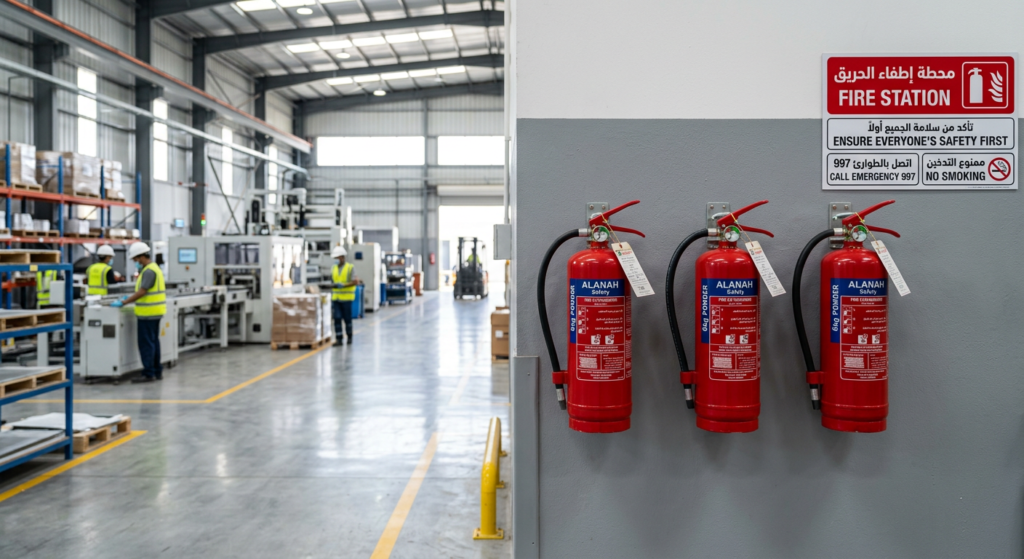
Walk through almost any factory in the Riyadh or Jeddah industrial zones and you’ll see red cylinders mounted at regular intervals along the walls. Most people barely notice them until something goes wrong. That’s the problem with fire extinguishers — they only get attention in the ten seconds when a fire is already starting, and by then it’s too late to discover the wrong type was hanging on the wall.
Choosing fire extinguishers for a factory is not the same task as picking one for a kitchen or an office. Factories combine multiple fire risks in one building — combustible packaging, flammable solvents, live electrical panels, sometimes reactive metals — and Saudi regulations expect facility owners to match the extinguisher to the hazard, not just tick a compliance box. Get it wrong, and an extinguisher can fail to control a fire, or in some cases make it worse.
This guide walks through exactly how to choose factory fire extinguishers in Saudi Arabia: what the fire classes mean for industrial settings, what Saudi Civil Defense and the Saudi Building Code (SBC 801) expect from you, how many units your floor plan actually needs, and where extinguishers fit alongside larger suppression systems.
Why Factory Fire Risk Is Different From Offices or Homes
A typical office deals with one dominant fire risk: ordinary combustibles like paper, furniture, and electrical faults. A factory floor is rarely that simple. Depending on what’s manufactured or stored, a single facility might have:
- Combustible raw materials or finished goods (cardboard, textiles, wood, plastics)
- Flammable liquids — solvents, oils, fuels, adhesives, paints
- Energized electrical equipment, control panels, and machinery
- In some plants, reactive metals such as aluminum dust, magnesium, or titanium shavings
Each of these behaves differently in a fire, and each needs a different extinguishing agent. A water-based extinguisher aimed at a solvent fire can spread burning liquid rather than putting it out. A standard powder extinguisher used on a metal fire can trigger a violent reaction. This is exactly why extinguisher selection in an industrial setting has to start with a proper hazard assessment, not a generic “one type fits all” purchase.
Saudi Arabia’s climate adds another layer. Extended summer heat affects pressure levels inside cylinders and accelerates wear on hoses, gauges, and seals — something facility managers in Riyadh, Jeddah, and Dammam need to factor into both selection and maintenance scheduling.
Understanding Fire Classes for Industrial Sites
Every extinguisher is rated for specific fire classes. Matching the extinguisher to the class of fire it will realistically face is the foundation of correct selection.
| Fire Class | Fuel Type | Common in Factories? |
|---|---|---|
| Class A | Wood, paper, textiles, plastics, packaging | Yes — nearly all factories |
| Class B | Flammable liquids — oils, solvents, fuels, paints | Yes — manufacturing, automotive, printing |
| Class C | Fires involving flammable gases | Yes — where gas lines or cylinders are present |
| Electrical | Energized equipment, control panels, wiring | Yes — nearly all factories |
| Class D | Combustible metals — magnesium, aluminum dust, titanium | Only in metalworking, machining, or chemical plants |
| Class K | Cooking oils and fats | Only in staff kitchens or canteens on site |
Most Saudi factories will need coverage for Classes A, B, and electrical fires as a baseline. Facilities that machine or process metal need to add Class D units specifically for those work zones — general-purpose extinguishers won’t cover this risk, and Saudi Civil Defense treats it as a distinct requirement for high-risk industrial areas.
Saudi Civil Defense and SBC 801 Requirements
Fire extinguisher selection in Saudi Arabia isn’t left to guesswork or supplier preference. It sits under a defined regulatory framework:
- Saudi Civil Defense (SCD) sets the enforcement standard for fire equipment approval, inspection, and placement across commercial and industrial buildings.
- SBC 801, the Saudi Building Code’s fire protection section, defines technical requirements for portable fire extinguishers, including type, rating, and spacing, and draws heavily on NFPA benchmarks.
- SASO (Saudi Standards, Metrology and Quality Organization) regulates the technical specification of fire control materials and equipment sold in the Kingdom.
In practice, this means every extinguisher installed in your factory should carry proper certification and labeling, be sized and rated for the specific hazard class present in that zone, and be logged in an inspection record that Civil Defense can review during a site visit. Facilities that skip this step don’t just risk a fire — they risk failing inspection, delaying operational licensing, or facing fines.
If you’re setting up a new production line or expanding an existing plant, it’s worth having your extinguisher plan reviewed alongside your broader fire safety design — alarm coverage, suppression systems, and emergency exits — rather than treating it as a separate purchase. Advanced Times Company for General Contracting designs fire safety systems this way: as one integrated plan rather than isolated components, coordinated with the relevant authorities for approval.
Key Factors That Determine the Right Extinguisher
Once the fire classes present in your facility are mapped out, five practical factors shape the final selection:
1. Hazard type per zone. A warehouse storing finished cardboard goods has different needs than a paint-mixing room next door. Extinguisher type should follow the zone, not the building as a whole.
2. Extinguisher capacity. Small offices attached to a factory may only need 1–2 kg units. Production floors and warehouses typically require 6–9 kg dry powder or CO2 units, and larger risk areas may call for wheeled, mobile extinguishers with higher agent capacity.
3. Environmental conditions. Dust-heavy production areas, high ambient heat near furnaces or ovens, and outdoor storage yards all put extra stress on extinguisher components. This affects both the type chosen and how often it needs inspection.
4. Equipment sensitivity. Server rooms, control rooms, and areas with expensive electronics shouldn’t rely on powder or water-based units, which can damage equipment even after the fire is out. Clean-agent options are the better fit here.
5. Accessibility and travel distance. SBC 801 sets maximum travel distances between any point on the floor and the nearest extinguisher. This is a placement rule, not just a “buy enough units” rule — extinguishers positioned in the wrong spot fail compliance even if the total count is correct.
Types of Fire Extinguishers Suited to Saudi Factories
| Extinguisher Type | Best For | Avoid Using On |
|---|---|---|
| Dry Powder (ABC) | Combustibles, flammable liquids, live electrical equipment — the most common all-purpose choice for factories | Confined spaces without ventilation |
| CO2 | Electrical panels, server rooms, sensitive machinery — leaves no residue | Open Class A fires where reflash risk is high |
| Foam | Flammable liquid fires — solvents, fuels, paints | Live electrical equipment |
| Wet Chemical | Cooking oil fires in on-site canteens (Class K) | Anything outside kitchen environments |
| Class D (Dry Powder — Metal) | Magnesium, aluminum dust, titanium fires in metalworking areas | General-purpose use — must stay specific to metal fire zones |
Most industrial sites in Riyadh and Jeddah end up using a mix — ABC dry powder as the baseline across production and storage areas, CO2 near electrical rooms and control panels, and Class D units confined strictly to metalworking bays. This layered approach, rather than a single extinguisher type throughout the building, is what actually satisfies both the practical risk and the Civil Defense requirement for hazard-appropriate coverage.
It’s also worth remembering that portable extinguishers are a first-response tool, not a substitute for a full suppression system. In high-value or high-risk zones — data rooms, electrical substations, chemical storage — a fixed suppression system such as FM-200 or Novec gas works alongside extinguishers rather than replacing them, giving automatic protection even when no one is present to respond manually.
How Many Extinguishers Does Your Factory Need?
There’s no single number that applies to every plant — it depends on floor area, hazard class, and layout. But the placement logic generally follows this pattern:
- Extinguishers should be positioned so no point on the production floor requires walking more than roughly 15–23 meters to reach one, with shorter distances required in higher-hazard zones.
- Each distinct hazard zone (chemical storage, machining bay, electrical room, warehouse racking) should be assessed and equipped independently rather than relying on units placed near the main entrance.
- Extinguishers must be mounted at an accessible height, clearly labeled in Arabic and English, and never blocked by stock, pallets, or equipment.
- Larger open-plan warehouses often need wheeled or mobile units in addition to wall-mounted ones, given the scale of potential fire spread.
A practical approach is to walk the facility with a fire safety professional, map hazard zones on the floor plan, and place units based on that map — not on guesswork or matching what a neighboring facility installed.
Common Mistakes Factories in Riyadh and Jeddah Make
A few patterns show up repeatedly during inspections and site assessments:
- Using one extinguisher type across the whole building. ABC dry powder in a server room, for instance, both under-protects the equipment and risks damaging it further.
- Treating extinguishers as a one-time purchase. Units left un-inspected for years lose pressure, and staff often don’t notice until it’s needed.
- Placing units for convenience rather than compliance. Extinguishers clustered near the entrance look tidy but leave far corners of a production floor unprotected.
- Ignoring Class D risk in metalworking areas. Many facility managers aren’t aware this is a distinct requirement until an inspection flags it.
- Skipping documentation. Civil Defense inspections ask for maintenance and inspection logs, not just visible equipment.
Inspection, Maintenance, and Refilling
Buying the right extinguisher is only half the job — Saudi regulations expect ongoing upkeep:
- Monthly visual checks, usually done by an on-site safety officer, confirming the unit is undamaged, pressurized, accessible, and unobstructed.
- Annual professional inspection by a certified technician, covering pressure testing, seal condition, and full functionality.
- Recharge or full maintenance roughly every 3–5 years depending on the extinguisher type, or immediately after any discharge.
- Documentation on-site, since Civil Defense officials expect a maintained inspection record during a site visit.
Given Saudi Arabia’s summer heat, extinguishers stored near furnaces, loading docks, or outdoor yards may need more frequent checks than the minimum schedule, since heat exposure accelerates pressure loss and seal wear.
Working With a Licensed Fire Safety Contractor
Choosing the right extinguisher is a technical decision, and getting it wrong doesn’t just risk a fire — it risks failing a Civil Defense inspection or delaying an operating license. That’s why most industrial facilities across Riyadh, Jeddah, and Dammam bring in a licensed contractor to assess the site rather than purchasing equipment independently.
Advanced Times Company for General Contracting works with commercial, residential, and industrial clients across Saudi Arabia to design fire extinguisher coverage as part of a complete fire safety plan — alongside fire alarm systems, gas suppression, sprinklers, and fire hydrant systems. Every design is coordinated with the relevant authorities for approval, and the team handles supply, installation, and ongoing maintenance so extinguishers stay compliant and functional long after installation day, including scheduled refilling and inspection services.
Frequently Asked Questions
Q1: What type of fire extinguisher is best for a factory in Saudi Arabia? Most factories need a mix rather than one type — ABC dry powder for general combustible and electrical coverage, CO2 near sensitive electronics, and Class D units specifically for metalworking zones handling reactive metals.
Q2: How often do factory fire extinguishers need to be inspected in KSA? Monthly visual checks by facility staff, an annual professional inspection by a certified technician, and a full recharge or maintenance service every 3–5 years, or immediately after use.
Q3: Are fire extinguishers alone enough for factory fire protection? No. Extinguishers are a first-response tool for small, controllable fires. High-risk or high-value zones typically also need fixed suppression systems, alarms, and detection equipment as part of a complete fire safety design.
Q4: Do factory fire extinguishers need Saudi Civil Defense approval? Yes. Extinguishers installed in commercial and industrial buildings must meet Civil Defense and SASO certification requirements, with proper labeling and documented inspection records.
Q5: How many fire extinguishers does a factory need? It depends on floor area and hazard zones rather than a fixed number — placement should ensure no point on the production floor is more than roughly 15–23 meters from an extinguisher, with tighter spacing in higher-risk areas.
Conclusion
Factory fire extinguisher selection in Saudi Arabia comes down to matching the right agent to the right hazard, placing units where SBC 801 and Civil Defense expect them, and keeping every extinguisher inspected and documented year-round. It’s a compliance requirement, but more importantly, it’s the difference between a fire that gets controlled in seconds and one that spreads before anyone can respond.
If you’re setting up a new facility or reviewing fire safety at an existing plant in Riyadh, Jeddah, or anywhere in the Kingdom, Advanced Times Company for General Contracting can assess your site and design a fire extinguisher and suppression plan that meets Saudi Civil Defense standards from day one. Get a free consultation to have your facility reviewed.