 Skip to content
ADVANCED TIMES COMPANY • FIRE SAFETY INSIGHTS
Walk into most Saudi facilities and you’ll find fire extinguishers mounted at regular intervals along every wall. Ask the facility manager why that particular type is hanging in that particular spot, and the honest answer is often “it’s what came with the building.” That gap — between having extinguishers and having the right extinguishers in the right places — is exactly what separates genuine fire readiness from a compliance checkbox.
| Quick Answer The seven portable fire extinguisher types used across Saudi industry are water (Class A), foam (Class A & B), ABC dry powder (Class A, B & C), CO2 (Class B & C electrical), wet chemical (Class K), clean agent (Class A, B & C), and Class D dry powder for combustible metals. Each one is built for a specific category of fire, and matching the correct type to each zone of a facility — rather than installing one type building-wide — is what actually determines whether an extinguisher works when it’s needed. |
Why Portable Extinguishers Still Matter Alongside Suppression Systems
Engineered suppression systems — FM200, Novec 1230, CO2, foam, and clean agent installations — protect a facility’s highest-value, fixed risks: data halls, control rooms, tank farms. But between the moment a fire starts and the moment an automatic system detects and activates, the person standing nearest to it needs something in hand right now. That’s the role a portable extinguisher plays, and it only works if the correct type is within reach of the specific hazard in front of it.
Systems and portables aren’t competing solutions — they’re complementary layers. Automatic suppression protects fixed, high-value zones around the clock. Portable extinguishers cover everywhere else: walkways, workstations, storage areas, and any space where a fire can start before a fixed system’s detection zone even reacts.
The 7 Portable Fire Extinguisher Types for Saudi Industry
1. Water Extinguisher — Class A
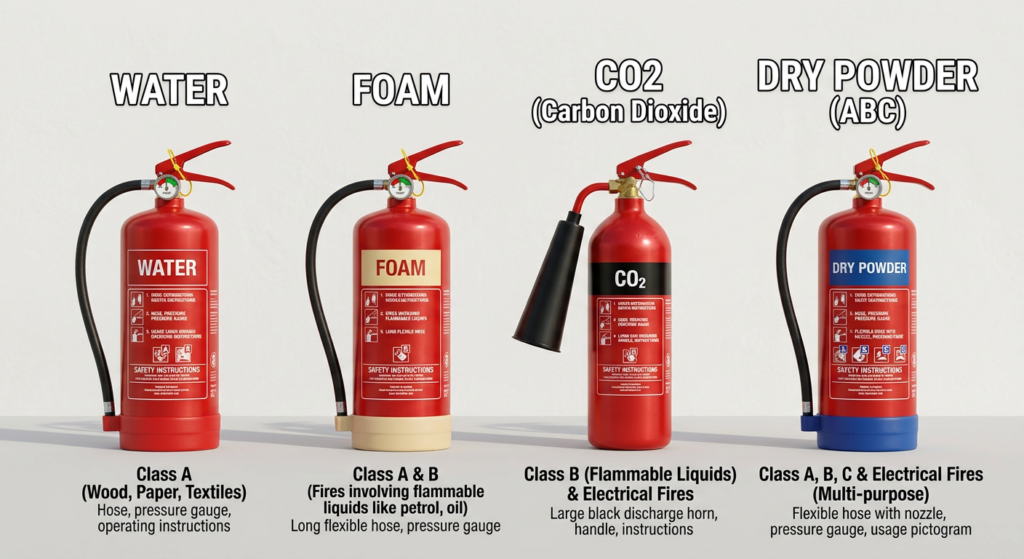
A water extinguisher cools burning material below its ignition temperature, which makes it effective against ordinary combustibles like paper, wood, textiles, and general storage materials. It’s the simplest extinguisher type, but it comes with an important limitation: it should never be used on electrical fires or flammable liquid fires, since it can spread burning liquid or create an electrocution risk.
Best for: Warehouses, offices, and general combustible storage areas.
2. Foam Extinguisher — Class A & B
Foam extinguishers form a smothering film across the surface of a burning liquid, cutting off its oxygen supply and preventing re-ignition — something a water extinguisher can’t safely do on a fuel fire. This makes foam a step up in versatility for facilities that handle both ordinary combustibles and flammable liquids in the same area.
Best for: Fuel storage areas, workshops, and loading bays.
3. ABC Dry Powder Extinguisher — Class A, B & C
The ABC dry powder extinguisher is the most common type found across Saudi industrial floors, and for good reason: it’s a genuine multi-purpose agent that interrupts the chemical reaction driving a fire across solids, liquids, and gases. Because most industrial facilities combine multiple fire risks in the same general area — packaging, machinery, occasional flammable materials — ABC powder is often the practical default for mixed-hazard zones.
Best for: Mixed-hazard industrial floors, general production areas, and vehicles.
4. CO2 Extinguisher — Class B & C (Electrical)
A CO2 extinguisher works by displacing the oxygen immediately around a fire, and critically, it leaves no residue behind — which is exactly why it’s the standard choice for fires involving live electrical equipment. Using water or powder on an energized electrical panel creates a serious safety risk; CO2 avoids that problem entirely while also protecting sensitive equipment from the mess a powder-based agent would leave behind.
Best for: Control rooms, generator rooms, switchgear, and server racks.
5. Wet Chemical Extinguisher — Class K
Wet chemical extinguishers are purpose-built for commercial and industrial kitchen fires. They react with hot cooking oils and fats to form a soapy, cooling layer across the surface, which suppresses the fire and — just as importantly — prevents the dangerous re-flash that can occur when a grease fire appears extinguished but reignites moments later.
Best for: Industrial and commercial kitchens, catering facilities, and food processing areas with deep-fat cooking equipment.
6. Clean Agent Extinguisher (Portable) — Class A, B & C
A portable clean agent extinguisher is essentially a handheld version of the same clean-agent technology used in fixed suppression systems like FM200 and Novec 1230. It extinguishes fire without leaving any residue, making it the safe choice for areas with sensitive electronics that a powder or foam extinguisher would otherwise contaminate or damage.
Best for: Data centers, laboratories, telecom rooms, and medical equipment areas.
7. Class D Dry Powder — Combustible Metals
This is a specialist extinguisher for a specialist hazard. Combustible metal dust and shavings — magnesium, titanium, aluminum, sodium — burn hot enough and react violently enough with water, CO2, or standard dry powder that they require a dedicated agent engineered specifically for metal fires. Using the wrong extinguisher type on a metal fire doesn’t just fail to help; it can make the fire measurably worse.
Best for: Metalworking shops, foundries, and any facility machining or storing reactive metals.
The 7 Types at a Glance
| Type | Fire Class | Best Suited To |
| Water | A | Paper, wood, textiles, general storage |
| Foam | A & B | Fuel storage, workshops, loading bays |
| ABC Dry Powder | A, B & C | Mixed-hazard industrial floors, vehicles |
| CO2 | B & C (electrical) | Control rooms, generators, switchgear |
| Wet Chemical | K | Commercial & industrial kitchens |
| Clean Agent | A, B & C | Data centers, labs, telecom rooms |
| Class D Powder | D (metals) | Metalworking, foundries, reactive metals |
Matching Extinguisher Type to Saudi Industrial Zones
Different sectors across the Kingdom carry very different fire risk profiles, and the extinguisher mix should reflect that rather than defaulting to one type building-wide:
- Oil & gas / petrochemical facilities typically need foam, CO2, and dry powder distributed across tank farms, process units, and control rooms — each zone carrying a different risk profile under one roof.
- Data centers and telecom facilities rely on clean agent portables to protect servers and network equipment without the residue damage a powder-based extinguisher would cause.
- Industrial kitchens and catering operations need wet chemical extinguishers specifically matched to grease and cooking-oil fires, which behave differently from ordinary combustible fires.
- Metalworking shops and foundries require Class D powder for reactive metal dust and shavings — a hazard type most general industrial facilities don’t have, but one that’s non-negotiable where it does exist.
Placement & Compliance Essentials
Choosing the right extinguisher type is only half the equation — placement and maintenance determine whether it’s actually usable when needed:
- Follow Saudi Building Code SBC 801 travel distances — the maximum distance between any point on a facility floor and the nearest extinguisher.
- Match type to zone, not the whole building. One extinguisher type rarely covers every hazard under a single roof, especially in facilities that combine office space, production floors, and specialized areas like kitchens or server rooms.
- Inspect monthly, service annually. A genuine hands-on check — gauge, pin, seal, hose, accessibility — catches problems a glance at the wall bracket never will.
- Keep documentation current. Valid inspection tags should be ready for Saudi Civil Defense review at any time, not scrambled together before a scheduled visit.
Frequently Asked Questions
What type of fire extinguisher is most commonly used in Saudi industrial facilities?
ABC dry powder extinguishers are the most common type across Saudi industry because they’re rated for Class A, B, and C fires, making them a practical default for mixed-hazard production floors and general industrial areas.
Can one extinguisher type cover an entire factory?
Generally, no. Most factories combine multiple fire risks — combustible materials, flammable liquids, live electrical equipment, and sometimes reactive metals — each requiring a different extinguishing agent. Zone-based selection, not a single building-wide type, is what actually protects every area correctly.
Why can’t you use a water extinguisher on an electrical fire?
Water conducts electricity, which creates a serious shock hazard if used on live electrical equipment. CO2 or clean agent extinguishers are the correct choice for electrical fires because they don’t conduct electricity and leave no residue behind.
What’s the difference between a CO2 extinguisher and a clean agent extinguisher?
Both leave no residue and are safe for electrical equipment, but clean agent extinguishers are generally preferred in spaces with highly sensitive electronics — like data centers — because of how the agent interacts with equipment and enclosed spaces compared to CO2.
Do commercial kitchens in Saudi Arabia require a specific extinguisher type?
Yes. Commercial and industrial kitchens with deep-fat cooking equipment require wet chemical (Class K) extinguishers, since ordinary Class A, B, or C extinguishers aren’t designed to safely suppress grease and cooking-oil fires without risking re-flash.
What extinguisher is used for metal fires?
Class D dry powder extinguishers are specifically formulated for combustible metal fires involving materials like magnesium, titanium, aluminum, or sodium. Standard extinguishers, including water, CO2, and ABC powder, can react dangerously with burning metal and should never be used on this hazard type.
How do portable extinguishers relate to fixed fire suppression systems?
They serve complementary roles. Fixed suppression systems like FM200, Novec 1230, and CO2 installations protect specific high-value, enclosed spaces automatically, while portable extinguishers cover the wider facility — anywhere a fire could start before a fixed system’s detection zone reacts.
Final Thoughts
Choosing the right portable fire extinguisher isn’t about picking a single “best” type — it’s about mapping all seven types against the specific hazards present in each zone of a facility, from a warehouse floor to a server room to an industrial kitchen. Getting that mapping right, and keeping every unit properly inspected and documented, is what turns a wall-mounted extinguisher from a compliance formality into equipment that actually works on the day it’s needed.
Advanced Times Company supplies and installs portable fire extinguishers alongside full suppression systems — FM200, Novec 1230, CO2, foam, and clean agent — across Jeddah, Riyadh, Dammam, and the wider Kingdom. Get a free consultation to have your facility’s extinguisher coverage reviewed and matched to every zone’s actual hazard profile.