 Skip to content
Industrial facilities are among the most challenging environments to protect from fire. Manufacturing plants, warehouses, chemical processing facilities, food production units, and logistics centers all contain different types of fire hazards that require carefully selected fire extinguishers. Choosing the wrong extinguisher can increase damage, put employees at risk, and delay emergency response.
In Saudi Arabia, factory owners must not only protect lives and assets but also comply with Saudi Civil Defense regulations, the Saudi Building Code (SBC), and internationally recognized standards such as the National Fire Protection Association (NFPA). A professional fire extinguisher selection walkthrough helps identify hazards, determine the appropriate extinguisher type, and ensure equipment is installed where it can be accessed quickly during an emergency.
This comprehensive guide explains how a factory fire extinguisher walkthrough is conducted, which extinguisher types are suitable for different industrial environments, and why professional fire safety planning is essential for businesses operating in Riyadh, Jeddah, Dammam, Jubail, Yanbu, NEOM, and throughout Saudi Arabia.
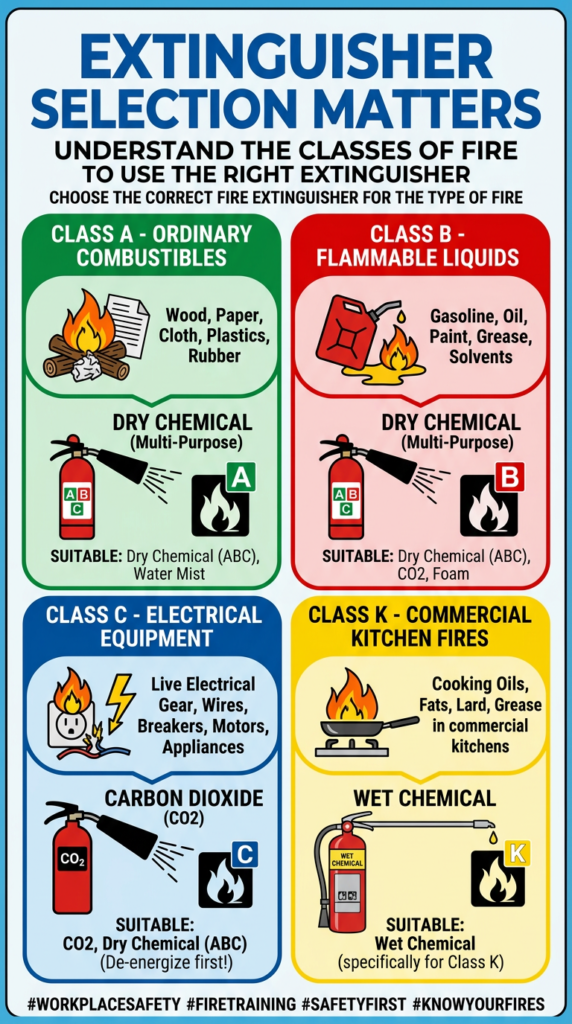
Why Fire Extinguisher Selection Matters
Many businesses assume that installing any fire extinguisher is enough to meet safety requirements. In reality, each extinguisher is designed to combat specific fire hazards. Selecting the wrong extinguisher can worsen a fire, create additional hazards, or expose workers to unnecessary risks.
For example, using a water extinguisher on an energized electrical panel can result in electric shock. Likewise, attempting to extinguish a flammable liquid fire with water may spread burning fuel instead of suppressing it.
A professional extinguisher selection process provides several important benefits:
- Protects employees during the initial stages of a fire
- Reduces equipment damage and production downtime
- Supports compliance with Saudi Civil Defense requirements
- Improves emergency preparedness
- Enhances business continuity
- Lowers long-term operational risk
- Demonstrates commitment to workplace safety
For factories handling combustible materials, chemicals, electrical systems, or high-value machinery, selecting the appropriate extinguisher is one of the most effective fire protection measures.
Understanding Fire Classes in Industrial Facilities
Before selecting a fire extinguisher, it is essential to identify the types of combustible materials present within the facility. Different materials burn differently, which is why fires are classified into specific categories.
Class A Fires
Class A fires involve ordinary combustible materials such as:
- Wood
- Cardboard
- Paper
- Packaging materials
- Fabrics
- Plastics
These fires are common in warehouses, storage rooms, offices, and production facilities.
Recommended extinguishers include:
- Water
- Foam
- ABC Dry Chemical
- Diesel
- Petrol
- Paints
- Solvents
- Industrial oils
- Lubricants
These hazards are frequently found in manufacturing plants, workshops, vehicle maintenance areas, and chemical storage facilities.
Suitable extinguishers include:
- Foam
- Carbon Dioxide (CO₂)
- Dry Chemical Powder
Class C Fires
Class C fires involve flammable gases including:
- LPG
- Propane
- Butane
- Natural gas
These hazards are common in industrial processing plants and facilities using pressurized gas systems.
Recommended extinguishers include:
Dry Chemical Powder
The gas supply should be isolated before extinguishing the fire whenever possible.
Electrical Fires
Electrical fires occur around energized equipment such as:
- Electrical panels
- Switchgear
- Server rooms
- Motor control centers
- Manufacturing equipment
- Data centers
Water-based extinguishers should never be used on energized electrical equipment.
Recommended extinguishers include:
- Carbon Dioxide (CO₂)
- Clean Agent systems
- Dry Chemical Powder
- Magnesium
- Titanium
- Sodium
- Lithium
These fires require specialized extinguishing agents specifically designed for combustible metals.
Using conventional extinguishers may increase the severity of these fires.
Types of Fire Extinguishers Used in Saudi Factories
Selecting the correct extinguisher depends on the specific hazards identified during the walkthrough.
Water Fire Extinguishers
Water extinguishers are effective against ordinary combustible materials.
They are commonly installed in:
- Administrative offices
- Packaging departments
- Storage rooms
- General warehouses
Advantages include:
- Cost-effective
- Easy to maintain
- Highly effective on Class A fires
Limitations:
- Not suitable for electrical fires
- Not suitable for flammable liquid fires
Foam Fire Extinguishers
Foam extinguishers are widely used in industrial facilities because they are effective on both Class A and Class B fires.
Typical applications include:
- Fuel storage
- Chemical handling
- Vehicle workshops
- Manufacturing plants
Foam creates a blanket over burning liquids, reducing oxygen and preventing reignition.
Carbon Dioxide (CO₂) Fire Extinguishers
CO₂ extinguishers are designed primarily for electrical hazards.
Common installation locations include:
- Electrical rooms
- Server rooms
- Control rooms
- Laboratories
- Communication centers
Advantages include:
- No residue after discharge
- Safe for electrical equipment
- Minimizes equipment damage
Dry Chemical Powder (ABC)
ABC Dry Chemical extinguishers are among the most versatile extinguishers available.
They are capable of suppressing:
- Class A fires
- Class B fires
- Electrical fires
Because of their versatility, they are commonly installed throughout industrial facilities where multiple fire hazards may exist.
However, the powder residue requires extensive cleaning after use and may damage sensitive electronic equipment.