 Skip to content
Why Portable Fire Extinguishers Fail in Factories in Saudi Arabia
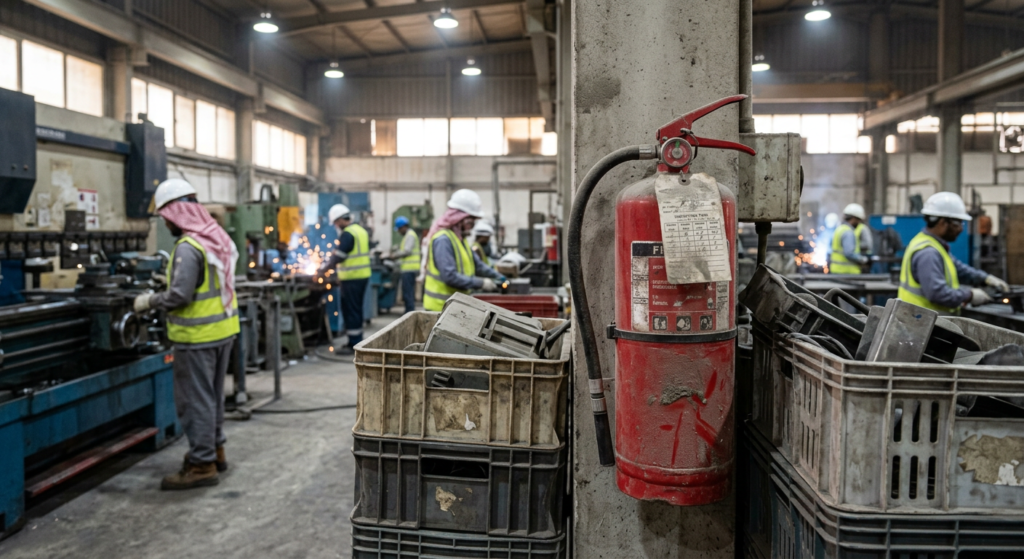
A fire extinguisher hanging on a factory wall in Riyadh, Jeddah, or Dammam can pass every visual glance and still fail the one moment it’s actually needed. That single fact is the reason this topic deserves more attention than it usually gets. Most conversations around factory fire safety in the Kingdom stop at “do we have extinguishers?” — the far more important question is “will they work?”
The short answer: portable fire extinguishers most commonly fail in Saudi factories because of wrong-agent mismatches, undetected pressure loss, climate-driven corrosion, skipped maintenance, blocked access, and untrained staff — not because the equipment was faulty out of the box. Every one of these causes is preventable with a properly designed inspection and maintenance program. The rest of this guide breaks down exactly why each one happens, how it shows up differently depending on where in Saudi Arabia your facility sits, and what a reliable program actually looks like.
The Real Problem: “Installed” Isn’t the Same as “Operational”
Saudi Civil Defense inspections confirm that an extinguisher is present, correctly labeled, and logged. What a single inspection visit often can’t catch is a unit that is technically compliant on paper but functionally compromised underneath it — low on internal pressure, mounted behind stacked inventory, or loaded with an agent that doesn’t match the hazard sitting a few meters away.
This gap between installed and operational is where the overwhelming majority of extinguisher failures actually live. It’s rarely a manufacturing defect. It’s almost always what happened — or didn’t happen — to the unit after it was mounted on the wall.
| On the Compliance Sheet | On the Factory Floor | |
|---|---|---|
| Status | Present, labeled, logged | Low pressure, blocked access, wrong agent nearby |
| What it looks like | Looks fine at a glance | Only surfaces during an actual fire or a hands-on test |
The 9 Reasons Portable Fire Extinguishers Fail in Saudi Factories
1. The Wrong Extinguisher Type for the Hazard
This is the single most common failure cause, and it isn’t really a failure of the equipment — it’s a failure of matching. A CO2 unit aimed at a burning stack of packaging won’t smother it the way a dry powder unit would. A water-based extinguisher used on a solvent or paint fire can spread burning liquid instead of extinguishing it. Powder discharged onto reactive metal dust can trigger a violent reaction rather than suppress the fire.
Most factories don’t have one uniform fire risk — a single facility might combine combustible packaging, flammable solvents, live electrical panels, and metalworking dust, each requiring a different extinguishing agent. Installing one extinguisher type across an entire building instead of mapping agent to hazard zone by zone is how the unit nearest the fire ends up being the wrong one on the day it matters.
2. Pressure Loss and Silent Discharge
Extinguishers lose pressure gradually, and the process is often invisible until someone actually needs the unit. A slow leak at the valve seal, a hairline crack in the hose, or a gauge that’s simply stuck can leave a cylinder reading “normal” at a glance while holding only a fraction of its rated charge underneath.
This is more dangerous than it sounds, because a partially discharged extinguisher creates false confidence — staff see it hanging in its bracket and assume it’s ready. The only reliable way to catch pressure loss is a genuine monthly visual check that actually reads the gauge, paired with an annual professional inspection that tests the seal and internal mechanism.
3. Saudi Arabia’s Climate Doesn’t Treat Every Facility the Same
This is where a national fire safety conversation has to move past one-size-fits-all advice, because the Kingdom’s climate isn’t uniform.
- Coastal facilities (Jeddah, Dammam, Khobar, Jubail) deal with high humidity and salt-laden air rolling in off the Red Sea and the Gulf, which accelerates corrosion on cylinder bodies, valve stems, and mounting brackets — particularly for units near loading docks, ports, or open bay doors.
- Inland facilities (Riyadh, Qassim, and the desert interior) face drier air but far more extreme daytime heat swings, which stress internal seals and valves through repeated pressure fluctuation across a single hot day.
- Industrial zones near ports or refineries often combine both heat and humidity stress with airborne industrial contaminants — dust, oil mist, chemical vapor — that shorten realistic extinguisher service life well below general manufacturer guidance.
A generic, one-size-fits-Saudi-Arabia maintenance schedule tends to under-inspect equipment that’s degrading faster because of a facility’s specific regional conditions. Coastal and exposed-zone units generally need shorter intervals between checks than the standard minimum.
4. Corrosion From Salt Air and Industrial Contaminants
Beyond general humidity, facilities near the Kingdom’s coastlines and ports deal with airborne salt settling on exposed metal surfaces. Over months, this accelerates corrosion on cylinder bodies, valve stems, and brackets — sometimes to the point where a lever seizes or a hose cracks at the fitting exactly when it’s squeezed under pressure during a real fire. Units in these zones benefit from more frequent visual inspection and, in some cases, protective housing that shields them from direct exposure without blocking access.
5. Skipped or Superficial Maintenance
A monthly “visual check” that’s really just someone glancing at a wall bracket in passing isn’t a genuine check. Real maintenance means confirming the pin is intact, the tamper seal is unbroken, the gauge needle sits in the operable range, the hose has no cracks, and the unit is unobstructed and accessible. Many facilities log this step as complete without anyone physically inspecting each cylinder.
Annual professional servicing catches what a visual check can’t — internal pressure testing, seal replacement, and confirmation that the extinguishing agent hasn’t degraded or caked, a common issue with dry powder units that sit unused for long stretches. Treating an extinguisher as a “buy once and forget it” purchase is one of the most frequent findings during post-incident reviews across the Kingdom.
6. Blocked, Hidden, or Poorly Placed Units
An extinguisher that works perfectly is still a functional failure if nobody can reach it in time. Inventory stacked in front of a wall bracket, equipment relocated to cover an access point, or units placed for tidiness near an entrance rather than distributed across actual hazard zones all turn compliant equipment into a non-event during an emergency.
Saudi Building Code SBC 801 sets maximum travel distances between any point on a factory floor and the nearest extinguisher for exactly this reason. When a facility’s layout changes — new machinery, reorganized storage, expanded production lines — extinguisher placement often doesn’t get reassessed alongside it, leaving blind spots that only surface during an actual fire or a detailed audit.
7. Expired Tags and Compliance Gaps
Every professionally inspected extinguisher should carry a current tag showing the date of its last service. When that tag is missing, expired, or was never updated after a refill, it usually signals that the underlying inspection didn’t happen either — the tag is a symptom, not the actual problem. Facilities that treat documentation as paperwork rather than a genuine maintenance trigger tend to have the same gap in the extinguishers themselves.
8. Staff Aren’t Trained to Use Them Under Pressure
An extinguisher that works perfectly is only as useful as the person holding it. Many factory workers have never actually operated one — they may recognize the general process but have never pulled a pin, aimed at the base of a fire, or felt how quickly the agent depletes. In a real fire, hesitation and incorrect technique waste the ten to fifteen seconds of discharge time an extinguisher provides, and that window is often the difference between a controlled incident and a full evacuation.
Basic hands-on fire extinguisher training, refreshed periodically rather than delivered once at hiring, is a low-cost step that directly determines whether working equipment actually gets used effectively.
9. Dust and Contamination Clogging the Nozzle
Facilities that generate fine dust — wood, textile fiber, powder-based materials — can end up with extinguisher nozzles partially clogged over time, especially on units mounted at floor level or near production equipment. A clogged nozzle reduces discharge pressure and range exactly when full output matters most, and this issue doesn’t show up on a pressure gauge — only a hands-on inspection catches it.
Failure Causes at a Glance
| Failure Cause | What It Looks Like on the Floor | How It’s Prevented |
|---|---|---|
| Wrong extinguisher type | Unit present, but rated for the wrong fire class in that zone | Hazard mapping by zone, not one type building-wide |
| Pressure loss | Gauge low or in the red, unit still hanging in its bracket | Monthly visual checks, annual professional testing |
| Heat and humidity wear | Faster seal degradation near docks, outdoor bays, or hot inland zones | Shorter inspection intervals for exposed units |
| Salt-air corrosion | Seized lever, cracked hose fitting, rusted bracket | Protective housing, more frequent inspection near coastal zones |
| Skipped maintenance | Tag present, but inspection was superficial or missed | Genuine hands-on monthly and annual checks |
| Blocked access | Pallets, stock, or equipment covering the unit | Regular walk-throughs tied to layout changes |
| Expired documentation | Missing or outdated inspection tag | Treat tags as maintenance triggers, not paperwork |
| Untrained staff | Hesitation or incorrect technique during a fire | Hands-on refresher training, not one-time onboarding |
| Clogged nozzle | Weak or reduced discharge despite normal-looking pressure | Physical inspection beyond the gauge reading |
Zone-Based Mapping in Practice: A Realistic Example
Consider a mid-sized manufacturing plant running three distinct areas under one roof: a warehouse for finished cardboard packaging, a paint-mixing room, and a control room housing the plant’s electrical panels and server rack.
Under a “one type for the whole building” approach, all three zones might carry identical ABC dry powder units — technically present, technically inspected, but mismatched to at least one of those hazards. A zone-based program instead places:
- ABC dry powder in the packaging warehouse
- Foam or CO2 near the paint-mixing area, depending on ventilation
- A clean-agent unit in the control room, where powder residue would damage the electronics it’s meant to protect
The extinguisher count on a compliance sheet might look identical either way. The difference only becomes visible during an actual fire.
The same logic applies to inspection frequency. A plant with sections facing the coast or with open loading bays doesn’t need to treat every extinguisher on the same monthly-and-annual clock. Units in exposed zones can reasonably move to a tighter schedule, while equipment in enclosed, climate-stable areas can follow the standard interval — as long as someone is actually tracking which units fall into which category.
What a Reliable Factory Extinguisher Program Actually Looks Like
Preventing these failures isn’t complicated, but it does require treating extinguisher management as an ongoing program rather than a one-time purchase:
- Zone-based hazard mapping so extinguisher type matches the actual fire risk in each area, not a blanket choice for the whole building
- Genuine monthly visual inspections that check the gauge, pin, seal, hose, and accessibility on every unit
- Annual professional servicing by a certified technician, including pressure testing and agent condition checks
- Adjusted inspection frequency for units exposed to regional heat, humidity, and salt air near coastal or open-air zones
- Clear, unobstructed placement reviewed whenever the floor layout changes
- Current inspection tags kept accurate and visible on every cylinder
- Periodic hands-on staff training, not a single session at induction
- Documented records ready for Civil Defense review at any time
Individually, none of these steps take long. Together, they’re the difference between a factory that merely passes inspection and a factory where the extinguishers actually work on the day they’re needed.
When to Bring In a Licensed Fire Safety Contractor
Some of this — monthly visual checks, basic staff awareness — can be managed internally with a clear checklist. But hazard mapping, professional pressure testing, and aligning extinguisher coverage with Saudi Building Code SBC 801 travel-distance rules are technical tasks that benefit from an experienced fire safety team, particularly for facilities that have grown or changed layout since their last full assessment.
This is especially worth doing before:
- A facility expansion or layout change
- A new production line or a change in stored materials
- Overdue professional pressure testing
- An upcoming Civil Defense inspection
Extinguisher coverage designed for a warehouse handling packaging looks very different from coverage designed for the same space once it starts storing solvents or running metalworking equipment — and a plan that isn’t updated alongside the facility tends to drift out of alignment without anyone noticing until an inspection or an incident flags it.
Frequently Asked Questions
What is the most common reason fire extinguishers fail in Saudi factories? Using the wrong extinguisher type for the hazard present in a given zone is the most frequent cause, closely followed by undetected pressure loss from a slow leak or an aging seal.
Does Saudi Arabia’s climate really affect fire extinguisher performance? Yes, and differently depending on the region. Coastal cities like Jeddah and Dammam combine heat with humidity and salt air, which accelerates corrosion. Inland cities like Riyadh face drier air but more extreme daytime heat swings that stress seals and valves through repeated pressure fluctuation.
How can I tell if a factory extinguisher has silently lost pressure? A monthly visual check of the gauge is the most reliable way — a needle outside the green operable range indicates a problem, even if the cylinder looks undamaged from the outside. Annual professional testing catches leaks a visual check might miss.
Is staff training really necessary if the extinguisher itself is working? Yes. A functioning extinguisher is only effective if the person using it knows how to aim, discharge, and act quickly. Untrained staff often waste the limited discharge window an extinguisher provides, turning a preventable incident into a larger one.
How often should factory extinguishers in coastal Saudi cities be inspected? More frequently than the standard minimum in many cases. Units exposed to salt air and humidity near coastal or open-air zones benefit from shortened inspection intervals compared to equipment in enclosed, climate-stable areas further inland.
What does Saudi Building Code SBC 801 require for extinguisher placement? SBC 801 sets maximum travel distances between any point on a factory floor and the nearest extinguisher, which is why layout changes — new machinery, reorganized storage, expanded production lines — should always trigger a placement review rather than leaving coverage as originally installed.
Can one extinguisher type cover an entire factory? Generally, no. Most factories combine multiple hazards — combustible packaging, flammable liquids, live electrical equipment, and sometimes reactive dust — each requiring a different extinguishing agent. Zone-based hazard mapping, not a single building-wide type, is what actually protects every area correctly.
Final Thoughts
A fire extinguisher that’s present but not working gives a factory the appearance of protection without the substance of it — and that gap usually isn’t visible until the moment it matters most. Every failure point covered here, from wrong-type mismatches to climate-driven corrosion to skipped maintenance, is preventable with a properly designed and consistently followed program, whether your facility sits on the coast in Jeddah, inland in Riyadh, or anywhere else across the Kingdom.
If your factory hasn’t had its fire extinguisher coverage reviewed against current hazard zones and Saudi Civil Defense requirements recently, Advanced Times Company for General Contracting designs and maintains fire extinguisher coverage across Jeddah, Riyadh, Dammam, and the wider Kingdom — alongside alarm systems, gas suppression, and sprinkler systems, fully coordinated with the relevant authorities. Get a free consultation to have your factory reviewed.