 Skip to content
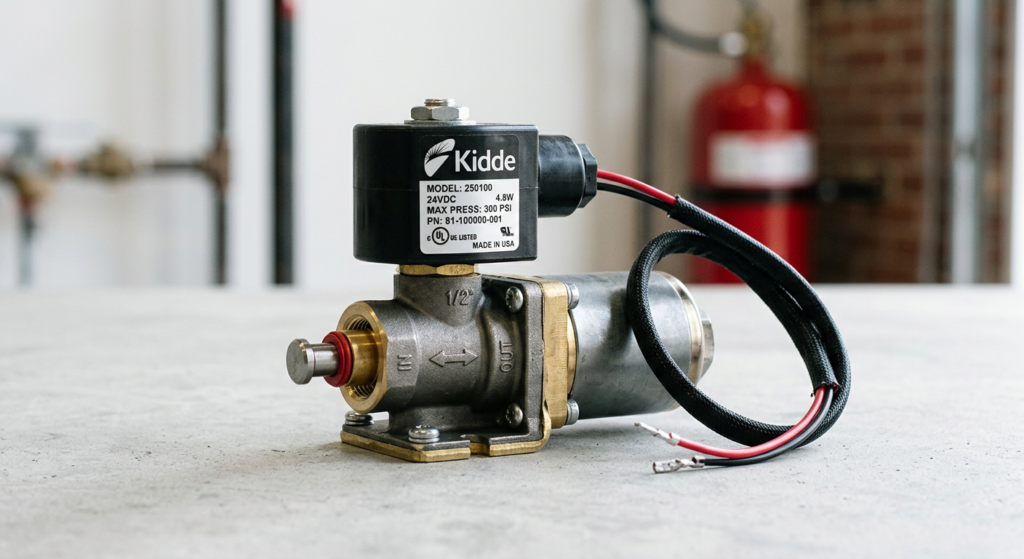
A Kidde solenoid is the electrically or pneumatically actuated valve component inside a Kidde fire suppression system that opens on a confirmed fire signal to release FM-200, Novec 1230, CO2, or inert gas into a protected space. In Saudi Arabia, these components are central to compliant fire protection for data centers, industrial facilities, telecom rooms, and commercial towers in Riyadh, Jeddah, Dammam, and beyond — and they require scheduled inspection to remain reliable.
If you manage a data center in Riyadh, an electrical room in Jeddah’s industrial zone, or a server closet in a Dammam office tower, the solenoid valve on your fire suppression cylinder is one of the most safety-critical — and most overlooked — components in the entire system. This guide explains what a Kidde solenoid is, how it works, the types available, and how to keep one compliant and functional under Saudi fire codes.
What Is a Kidde Solenoid?
A Kidde solenoid is an electromechanical or pneumatic trigger — not a gas source. When a Kidde fire suppression control panel confirms a genuine fire condition and completes any programmed discharge delay, it energizes the solenoid. The solenoid then either:
- Directly opens a cylinder or stop valve (electric solenoid), or
- Releases nitrogen pilot pressure that mechanically opens a 3-way directional ball valve (pneumatic solenoid)
The result is the same: the extinguishing agent — FM-200, Novec 1230, CO2, or inert gas such as IG-55 — is released into the protected hazard, typically within seconds of a confirmed alarm.
Kidde solenoids are shipped from the factory in the closed (normally closed / N.C.) position and are mounted on cylinder valves, stop valves, or directional valves depending on the system architecture. Most units include a manual override, allowing trained personnel to actuate the system mechanically if the electrical or pneumatic signal path fails.
Slide: What is a Kidde solenoid — quick facts
How a Kidde Solenoid Works: The Actuation Sequence
Understanding the actuation sequence helps facility teams in Saudi Arabia troubleshoot faults and specify the right system design:
- Fire is detected — cross-zoned detectors confirm a genuine fire condition to prevent false discharges.
- The panel sends a signal — after any programmed discharge delay expires, the control panel energizes the solenoid circuit.
- The solenoid energizes — the electric plunger lifts, or pneumatic pilot pressure passes through the solenoid body.
- The valve opens — the cylinder valve, stop valve, or 3-way directional valve rotates or opens to permit agent flow.
- The agent discharges — FM-200, Novec 1230, CO2, or inert gas floods the hazard area, typically within seconds.
Slide: How a Kidde solenoid works — actuation sequence
Types of Kidde Solenoids
Not every Kidde solenoid is built the same way. The right type depends on the system architecture, the hazard classification of the space, and whether the installation needs explosion-proof certification.
1. Pneumatic Solenoid
Standard on directional valve actuators in engineered systems (such as Kidde ECS/ADS). It uses a nitrogen pilot signal to open 3-way ball valves and is provided from the factory in the closed position. A pressure relief device is required downstream, and the manufacturer’s maximum pressure rating of roughly 150 PSIG (10.34 bar) must not be exceeded.
2. Explosion-Proof Electric Solenoid
Operates at a nominal 24 Vdc with low current draw and is UL-listed as suitable for hazardous locations — Class I Division 1 Groups C and D, and Class II Division 1 Groups E, F, and G. It is compatible with FM-200 systems (including ADS configurations), CO2 systems, and FE-13 systems, and features a rugged brass body built for a wide operating temperature range.
3. Direct-Acting Solenoid Valve
Mounted directly on a single cylinder valve for compact, standalone releases — commonly seen on CO2 cylinder assemblies. This design minimizes pneumatic hardware and is well suited to smaller, single-hazard protection zones.
Slide: Types of Kidde solenoids
Key Technical Specifications
| Parameter | Typical Value / Rating |
| Operating voltage (electric) | Nominal 24 Vdc, low current consumption |
| Max. pilot pressure (pneumatic) | 150 PSIG / 10.34 bar (downstream pressure relief required) |
| Body material | Rugged brass body |
| Hazardous location rating | Class I Div 1 Groups C & D; Class II Div 1 Groups E, F & G |
| Actuation method | Control panel signal or mechanical manual actuator |
| Compatible agents | FM-200, Novec 1230, CO2, IG-55 / IG-100 inert gas |
| Valve types operated | Cylinder valves, stop valves, 3-way directional valves |
| Default state | Factory-shipped closed (normally closed) |
Slide: Key technical specifications table
Where Kidde Solenoids Are Used in Saudi Arabia
Saudi Arabia’s rapid growth in data infrastructure, industrial capacity, and commercial real estate has driven strong demand for compliant, solenoid-actuated clean-agent suppression:
- Data centers & server rooms — clean-agent release protects sensitive electronics with zero residue.
- Industrial & petrochemical facilities — rapid actuation for high-risk process and electrical rooms.
- Telecom & control rooms — compact direct-acting solenoids for single-cylinder protection.
- Commercial towers in Riyadh, Jeddah, and Dammam — directional valve systems for multi-hazard, zoned protection.
- Warehouses & archives — CO2 and inert gas systems safeguarding valuable stored assets.
- Marine & engine rooms — explosion-proof solenoids rated for hazardous environments.
Slide: Where Kidde solenoids are used in Saudi Arabia
Warning Signs of a Failing Kidde Solenoid
A fire suppression system is only as reliable as its actuation path. These are the most common early indicators of solenoid trouble seen on inspection in the Kingdom:
- No response to a test or manual signal — often a coil, wiring, or plunger fault.
- Nitrogen pilot pressure loss — seal degradation in the pneumatic solenoid or pilot line.
- Corrosion or pitting on the brass body — from environmental exposure or chemical contact.
- Panel reports a supervisory/trouble fault — coil resistance out of range or broken continuity.
- Manual override sticks or resists movement — mechanical wear on the override pin or spring.
- Inspection interval overdue — periodic testing recommended by NFPA 2001 has lapsed.
Slide: Warning signs of a failing solenoid
Maintenance & Testing Checklist
Routine inspection keeps a solenoid-actuated suppression system ready to perform when it matters. A thorough maintenance visit should cover:
- Visual inspection of the solenoid body for corrosion, cracks, or leaks
- Coil resistance and continuity verification against manufacturer specification
- Functional test of electrical or pneumatic actuation (with agent supply isolated)
- Confirmation that nitrogen pilot pressure sits within its rated range (≤150 PSIG)
- Free movement check on the manual override mechanism
- Inspection of wiring, terminals, and explosion-proof housing seals
- Verification that the panel supervisory circuit shows no fault at the solenoid
- Documented logging in line with NFPA 2001 and Saudi Civil Defense maintenance intervals
Most fire codes and manufacturer guidance point to an annual minimum inspection frequency for solenoid-actuated suppression systems, with more frequent checks in harsh industrial or coastal environments common across Saudi Arabia’s Eastern Province.
Slide: Maintenance and testing checklist
Why This Matters for Compliance in Saudi Arabia
Fire suppression systems in the Kingdom are subject to Saudi Civil Defense approval and are commonly designed and maintained to NFPA 2001 standards for clean-agent extinguishing systems. A solenoid that fails silently — without an obvious visible fault — can leave an entire suppression system non-functional despite the cylinders, piping, and detection network all being correctly in place. This is precisely why solenoid-specific testing, not just cylinder pressure checks, needs to be part of every maintenance visit.
Frequently Asked Questions
What is a Kidde solenoid used for?
It is the actuation component that opens a fire suppression cylinder, stop valve, or directional valve to release the extinguishing agent once a fire is confirmed by the control panel.
Is a Kidde solenoid the same as a fire suppression cylinder?
No. The cylinder stores the pressurized extinguishing agent; the solenoid is the valve-opening trigger mounted on or connected to the cylinder or directional valve.
What voltage do Kidde electric solenoids operate at?
Most Kidde electric and explosion-proof solenoids operate at a nominal 24 Vdc with low current consumption.
How often should a Kidde solenoid be tested in Saudi Arabia?
At minimum annually, in line with NFPA 2001 guidance and Saudi Civil Defense requirements, with more frequent checks recommended in industrial or coastal environments.
Can a Kidde solenoid be manually triggered if the electrical signal fails?
Yes. Most Kidde solenoids include a mechanical manual override for use when an electrical or pneumatic signal cannot reach the valve.
Which fire suppression agents work with Kidde solenoid-actuated systems?
FM-200, Novec 1230, CO2, and inert gases such as IG-55 and IG-100 are all compatible with Kidde solenoid-actuated valve systems, depending on the specific model.
Who supplies and maintains Kidde solenoid systems in Saudi Arabia?
Advanced Times Company for General Contracting supplies, installs, and maintains fire suppression systems, including solenoid-actuated FM-200 and Novec gas systems, for clients across Riyadh, Jeddah, Dammam, and the wider Kingdom.
Protect Your Facility with Advanced Times Company
Whether you’re specifying a new clean-agent suppression system or maintaining an existing Kidde solenoid installation, Advanced Times Company for General Contracting provides certified supply, installation, and maintenance of fire suppression systems — including FM-200 and Novec gas cylinders and solenoid components — across Saudi Arabia.
Key services
- Certified supply & installation of fire suppression systems and solenoid components
- Scheduled maintenance, solenoid diagnostics, and gas cylinder refilling
- Code-compliant design coordinated with Saudi Civil Defense and NFPA 2001
- Nationwide coverage across Riyadh, Jeddah, Dammam, and industrial sites throughout the Kingdom
Slide: Why choose Advanced Times Company
Slide: Protect your facility today — contact
�� Office No. 14A, 2nd Floor, Rasheed & Othaim Center, Salah Al-Ain St, Malaz, Riyadh, KSA
�� +966 50 393 4758
✉ Info@advancedtimescompany.com