 Skip to content
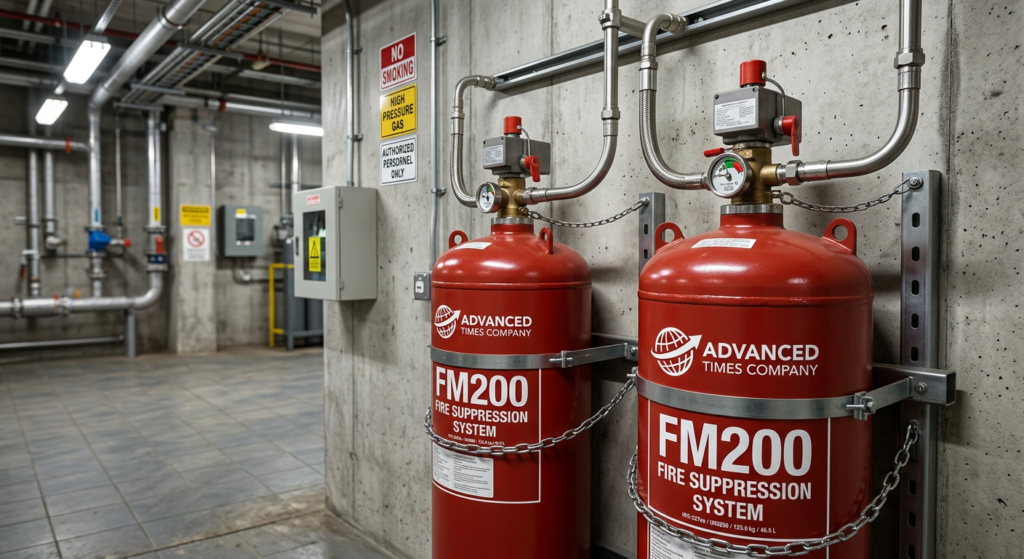
An FM200 gas cylinder is a pressurized steel vessel that stores HFC227ea, a clean firesuppression gas that extinguishes fires in roughly 10 seconds without water, foam, or residue. In Saudi Arabia, FM200 systems are the standard choice for protecting data centers, hospitals, banks, telecom rooms, and oil & gas control rooms, and they are designed with reference to NFPA 2001 and the Saudi Building Code (SBC 801), as enforced by the Saudi Civil Defense.
If you manage a server room in Riyadh, a control room in Dammam, or a hospital IT suite in Jeddah, choosing the right FM200 gas cylinder — and the right supplier — is one of the most consequential fire-safety decisions you’ll make this year. This guide breaks down everything a facility owner, consultant, or contractor needs to know: what FM200 is, how cylinder capacity is calculated, how installation works, what compliance looks like under Saudi regulations, and how to avoid the mistakes that quietly compromise fire protection systems across the Kingdom.
What Is an FM200 Gas Cylinder?
An FM200 gas cylinder is a certified pressure vessel engineered to store HFC227ea (Heptafluoropropane), pressurized with dry nitrogen, ready for instant release into a protected space through a fixed pipe and nozzle network. “FM200” is the trade name most commonly used across the Gulf region for HFC-227ea clean-agent systems, and it has become the default specification for enclosed, high-value spaces where water damage is unacceptable.
Unlike sprinklers or foam systems, an FM200 gas suppression system doesn’t get triggered on its own — it’s part of an integrated fire detection and control loop. When a fire is detected by smoke or heat sensors, the control panel signals the cylinder valve to open, releasing the agent through the piping and nozzles within seconds.
Key facts facility managers should know:
- Discharges within approximately 10 seconds of activation
- Leaves zero residue — safe for servers, panels, and archives
- Available in multiple cylinder capacities for single rooms or manifold (multi-cylinder) systems
- Commonly engineered with reference to NFPA 2001, the internationally recognized clean-agent design standard
- Requires periodic recharge after any full or partial discharge
How FM200 Fire Suppression Works
FM200 suppresses fire mainly through heat absorption, interrupting the chemical chain reaction that sustains combustion, while also slightly reducing oxygen concentration. Because the agent is stored as a liquefied, pressurized gas, it vaporizes almost instantly on discharge and floods the entire protected enclosure — not just the point of ignition — which is why room integrity (sealed doors, closed dampers, minimal penetrations) matters so much to system performance.
This “total flooding” approach is precisely why FM200 is specified for enclosed technical spaces rather than open, ventilated areas: the agent needs to reach and hold a minimum design concentration long enough to fully extinguish the fire.
Why FM200 Is the Preferred Choice in Saudi Arabia
Saudi Arabia’s digital, financial, and industrial expansion under Vision 2030 has significantly increased the number of mission-critical enclosed spaces that cannot tolerate water damage or extended downtime. Across Riyadh, Jeddah, Dammam, Khobar, Makkah, and NEOM, new data centers, smart government facilities, hospitals, and telecom hubs are being built or upgraded — and nearly all of them specify clean-agent fire suppression at the design stage.
FM200 gas cylinders are widely specified in:
- Data centers and server rooms — protecting hardware without water or foam damage
- Hospitals and healthcare facilities — safeguarding imaging equipment, IT infrastructure, and archives
- Banks and financial institutions — protecting vaults, servers, and records
- Oil & gas control rooms — suppressing fire around electrical and control systems
- Government and telecom facilities — protecting switchgear and communications equipment
- Airports, universities, and commercial towers — protecting operational and IT infrastructure
- Manufacturing and power generation plants — protecting automation and control panels
In every one of these environments, the core advantage is the same: FM200 extinguishes the fire quickly and leaves the protected equipment operational, minimizing both direct damage and business downtime.
FM200 Cylinder Capacities Explained
FM200 cylinders are manufactured in a range of capacities to match different room volumes and hazard types. While exact model numbers vary by manufacturer, cylinders are generally grouped as follows:
| Cylinder Category | Typical Use Case |
| Small capacity cylinders | Compact server rooms, single equipment enclosures, small electrical rooms |
| Medium capacity cylinders | Mid-size data halls, control rooms, telecom rooms |
| Large capacity cylinders | Large IT floors, industrial electrical rooms, multi-zone facilities |
| Manifold (multi-cylinder) systems | Large industrial plants, multi-room data centers, facilities with several protected zones sharing one bank of cylinders |
There is no single “correct” size — the right capacity is always the output of an engineering calculation, not a guess based on floor area alone. A qualified supplier will confirm exact cylinder sizing after a site assessment and agent-quantity calculation specific to your facility.
How to Choose the Right Cylinder Capacity
Selecting the correct FM200 gas cylinder capacity is one of the most important engineering decisions in a clean-agent fire suppression project. Undersizing leaves a room under-protected; oversizing wastes budget and cylinder space. Five factors drive the calculation:
1. Room Dimensions
Length, width, height, and total enclosed volume are the starting point for calculating the required quantity of HFC-227ea. Larger volumes typically require larger cylinders or multi-cylinder manifold configurations.
2. Type of Hazard
Electrical equipment, data processing hardware, telecom systems, control systems, and flammable liquids each carry a different design concentration requirement under NFPA 2001, which directly affects the agent quantity needed.
3. Room Integrity
For total-flooding systems to work, the enclosure must retain the extinguishing concentration long enough to suppress the fire. Door seals, ventilation openings, cable penetrations, raised flooring, and ceiling voids all affect how well the room holds the agent — and a room integrity (door fan) test is often used to verify this before commissioning.
4. Environmental Conditions
Ambient temperature, altitude, occupancy, and ventilation system behavior all influence how the agent performs once discharged, and are factored into the engineering calculation — particularly relevant in Saudi Arabia’s high ambient-temperature environments.
5. Future Expansion
Many Saudi facilities — especially data centers and industrial plants — plan for growth. Specifying a scalable manifold system upfront can significantly reduce the cost of later expansions or renovations.
Maintenance, Refilling & Recharge
FM200 cylinders are a life-safety asset and require routine maintenance to stay mission-ready:
- Visual inspection — cylinder condition, valve assembly, pressure gauges, safety seals, mounting brackets, hoses, and labels
- Pressure monitoring — routine checks to catch slow pressure loss, valve leakage, or seal deterioration before it becomes a failure
- Pipe network inspection — checking for corrosion, physical damage, loose supports, and blockages
- Detection system testing — smoke detectors, heat detectors, manual call points, and alarms tested periodically
- Room integrity testing — confirming the enclosure can still hold the extinguishing concentration for the required duration
After any discharge — whether from an actual fire, accidental activation, or testing — the cylinder must be professionally recharged before returning to service. The typical recharge cycle includes: inspection, cylinder removal, valve examination, internal assessment, refilling with certified HFC-227ea, pressure verification, leak testing, reinstallation, and system recommissioning. This should only ever be performed by qualified personnel.
FM200 System Components & Accessories
A complete FM200 gas suppression system is more than a single cylinder — it’s an integrated set of precision components:
- FM200 gas cylinders
- Cylinder valve assemblies and pressure gauges
- Electric, manual, and pneumatic actuators
- Flexible discharge hoses
- Check valves and directional valves
- Manifold systems (for multi-cylinder banks)
- Discharge piping and nozzles
- Pressure switches and cylinder brackets
- Fire detection devices, alarm control panels, manual release stations, and abort switches
Compatibility between every one of these components is critical — mixing cylinders, valves, and actuators from incompatible product lines is one of the most common (and most costly) mistakes in FM200 system design.
Saudi Regulations & International Standards
Fire suppression systems in Saudi Arabia must be designed, installed, and maintained in line with recognized engineering standards and local regulatory requirements. In practice, this means most FM200 gas suppression projects reference:
- NFPA 2001 — Standard for Clean Agent Fire Extinguishing Systems, the primary international design reference for FM200/HFC-227ea systems
- NFPA 70 — National Electrical Code, where electrical integration applies
- NFPA 72 — Fire Alarm and Signaling Code, governing detection and notification devices
- SBC 801 (Saudi Building Code – Fire Protection) — the Kingdom’s national fire-protection code, developed with reference to international fire codes and enforced through the building permitting process
- Saudi Civil Defense (General Directorate of Civil Defense) requirements — the enforcing authority responsible for fire safety certification, inspection, and approval of protected facilities in Saudi Arabia
Every project should also account for the Authority Having Jurisdiction (AHJ), occupancy classification, and any project-specific consultant specifications. Because requirements can vary by city, project type, and building use, system design should always be reviewed by a qualified fire protection engineer familiar with current Saudi Civil Defense and SBC 801 requirements before submission for approval.
Common Mistakes When Selecting FM200 Cylinders
Even experienced project teams occasionally get these wrong:
- Sizing by room area alone — Ignoring hazard type, ceiling height, and enclosure leakage in the capacity calculation
- Ignoring future expansion — Choosing a fixed-capacity system when the facility is likely to grow
- Mixing incompatible components — Combining cylinders, valves, and actuators from different product lines
- Delaying maintenance — Treating inspection schedules as optional rather than life-safety critical
- Choosing inexperienced suppliers — Awarding fire suppression work based on price alone rather than engineering competence and after-sales support
Project Lifecycle: Consultation to Commissioning
A well-run FM200 project typically follows seven stages, from first conversation to long-term support:
- Initial Consultation — Understanding the facility, hazards, and objectives
- Site Survey — Detailed assessment of room dimensions, hazard classification, and installation conditions
- Engineering & System Design — Hydraulic calculations, cylinder sizing, piping layout, nozzle placement
- Product Supply — Delivery of certified FM200 cylinders and compatible components
- Installation — Cylinders, piping, nozzles, detection, and control equipment installed per approved drawings
- Testing & Commissioning — Full functional verification before handover
- Ongoing Maintenance & Support — Periodic inspection and preventive maintenance across the system’s operational life
FM200 vs. Other Fire Suppression Systems
| Factor | FM200 (Clean Agent) | Water Sprinklers | CO₂ Systems |
| Residue after discharge | None | Water damage likely | None, but not safe for occupied spaces |
| Safe for electronics/servers | Yes | No | Not while occupied |
| Discharge time | ~10 seconds | Minutes (activation-dependent) | Seconds |
| Typical use case | Data centers, control rooms, archives | General building occupancy | Unoccupied high-hazard enclosures |
| Human occupancy during discharge | Generally safe at design concentration | Safe | Hazardous — evacuation required |
FM200 is not a replacement for sprinklers in general building occupancies — the two are often used together as part of a layered fire protection strategy, with FM200 reserved for enclosed, high-value, equipment-critical spaces.
Frequently Asked Questions
What is an FM200 gas cylinder? An FM200 gas cylinder is a pressure vessel that stores HFC-227ea, a clean-agent fire suppression gas used in automatic fire suppression systems to protect sensitive equipment and enclosed spaces.
What is FM200 gas made of? FM200 is the trade name for HFC-227ea (Heptafluoropropane), a clean gaseous fire-suppression agent that extinguishes fires rapidly without leaving residue.
Is FM200 safe for electronic equipment? Yes. FM200 leaves no residue and does not damage servers, telecommunications equipment, or electrical panels when the system is properly designed and installed.
How quickly does FM200 extinguish a fire? Most FM200 gas suppression systems are designed to discharge the extinguishing agent within approximately 10 seconds of activation.
Does FM200 leave residue after discharge? No. HFC-227ea evaporates after discharge and leaves no powder, foam, or water residue behind.
Can FM200 replace sprinkler systems? No. FM200 protects sensitive equipment and enclosed hazards, while sprinklers remain essential for general building occupancy — the two are commonly used together as part of an overall fire strategy.
How often should FM200 systems be inspected in Saudi Arabia? Inspection intervals depend on NFPA 2001 requirements, manufacturer recommendations, and Saudi Civil Defense/SBC 801-driven maintenance schedules specific to the facility and occupancy type.
Are different FM200 cylinder capacities available? Yes. FM200 cylinders are supplied in multiple capacities, from small single-room systems to large manifold configurations for industrial facilities.
Do FM200 cylinders require maintenance? Yes. Routine inspection, pressure checks, functional testing, and preventive maintenance are required to keep the system ready for an emergency.
Can an existing fire suppression system be upgraded to FM200? In many cases, yes, subject to an engineering assessment of compatibility with existing infrastructure.
FM200 gas cylinders remain one of the most reliable, widely specified clean-agent fire suppression solutions for protecting mission-critical facilities across Saudi Arabia — from server rooms in Riyadh to control rooms in the Eastern Province. The right outcome depends on three things: an accurate engineering calculation for cylinder capacity, installation and commissioning that follows NFPA 2001 and SBC 801 requirements, and a maintenance program that keeps the system ready for the day it’s actually needed.
If you’re planning a new installation, expanding an existing FM200 gas suppression system, or upgrading aging fire protection infrastructure, work with a supplier who can support the full project lifecycle — from site survey through engineering, supply, installation, commissioning, and ongoing maintenance.
Advanced Times Company (ATC), based in Riyadh, supplies premium FM200 gas cylinders in multiple capacities along with complete fire protection solutions for commercial, industrial, government, and healthcare projects across Saudi Arabia. Contact ATC to request a quotation or speak with a fire protection specialist about the right FM200 gas cylinder solution for your facility.
Disclaimer: This article is intended for general informational purposes. Fire suppression system design, cylinder sizing, and compliance requirements should always be confirmed with a qualified fire protection engineer and verified against current Saudi Civil Defense and SBC 801 requirements for your specific project and jurisdiction.