
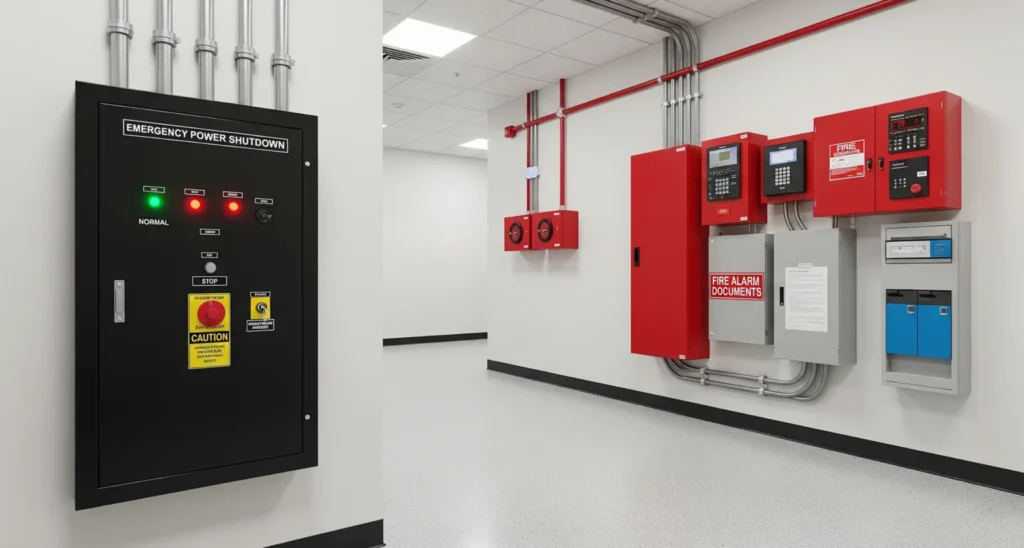
Airports require carefully coordinated fire detection and alarm arrangements to support passenger safety, protect operational infrastructure and facilitate an organised emergency response. From passenger terminals and baggage-handling areas to electrical rooms, plant spaces and commercial concessions, each area can present different fire risks and operational requirements.
For organisations evaluating Airport Fire Alarm Systems Saudi Arabia, selecting an appropriate solution involves more than choosing detectors and an alarm control panel. Project teams must consider the building’s intended use, environmental conditions, system interfaces, airport operating procedures, documentation requirements and the applicable authority approval process.
This guide explains the principal considerations for airport fire detection, fire alarm system design and installation planning, contractor evaluation and maintenance. It is intended for airport facility managers, main contractors, consultants, building owners and procurement teams working across Saudi Arabia.
Advanced Times Company for General Contracting provides fire safety solutions and related contracting services. Its published offerings include fire suppression system supply and installation, tube detection fire suppression systems, civil work, electrical work, emergency doors and glass work. The exact scope of any airport fire alarm project should be confirmed with the company before a quotation or service commitment is made.
Table of Contents
- What Are Airport Fire Alarm Systems?
- Why Airport Fire Detection Requires Careful Planning
- Main Components of Airport Fire Alarm Systems
- Airport Fire Alarm System Options and Scope Comparison
- Saudi Compliance, Airport Approvals and Documentation
- Environmental and Operational Considerations
- How to Evaluate Fire Alarm System Contractors in Saudi Arabia
- What Affects Project Pricing and How to Request a Quotation
- Who Should Reconsider This Procurement Approach?
- Maintenance Planning for Airport Fire Detection Systems
- Frequently Asked Questions
- Contact Advanced Times Company
What Are Airport Fire Alarm Systems?
An airport fire alarm system is an arrangement of detection devices, control equipment, alarm notification devices and associated interfaces designed to identify fire conditions and communicate the appropriate signals.
Unlike a small commercial installation, an airport may contain multiple buildings, operational zones, passenger areas, service corridors and restricted technical spaces. A project must therefore account for the characteristics of each area rather than treating the entire facility as a uniform environment.
Depending on the approved design, an airport fire alarm system may support:
- Early identification of smoke or other specified fire indicators.
- Audible and visual warning to occupants.
- Transmission of alarm and fault information to designated control locations.
- Coordination with approved building management or emergency systems.
- Monitoring of system faults and relevant operational conditions.
- Support for evacuation procedures and emergency response.
The precise functions depend on the system design, the facility’s operating requirements and the applicable authority’s instructions.
Airport fire detection systems must be designed around the actual hazards and approved project requirements. A system suitable for an office may not be appropriate for every terminal, baggage-handling area, plant room or technical enclosure.
Why Airport Fire Detection Requires Careful Planning
Airports combine high occupancy with complex building services and strict operational controls. Fire detection must be considered alongside passenger movement, evacuation arrangements, business continuity and the consequences of an unwanted alarm.
Different areas have different fire risks
Passenger terminals, retail concessions, kitchens, electrical rooms, server spaces, baggage-handling facilities and maintenance workshops may have different environmental conditions and ignition sources.
Detector selection and placement should therefore follow a competent engineering assessment. The system designer must consider the intended use of each space, relevant fire scenarios, ventilation, ceiling configuration and the required response.
Alarm management affects operations
An unwanted alarm can lead to investigation, disruption and additional operational demands. Conversely, unsuitable detection arrangements can delay identification of a developing fire. A responsible design seeks to provide appropriate detection while managing the risk of nuisance alarms. Detector technology, placement, maintenance and the surrounding environment all contribute to performance.
Integration must be defined
Depending on the facility and approved design, a fire alarm system may interface with selected notification systems, ventilation controls, access-control arrangements, lifts, fire suppression controls or a central monitoring platform.
These interfaces must be explicitly defined. A contractor should not assume that every existing building system can communicate with a proposed fire alarm panel or that an interface is automatically approved.
Main Components of Airport Fire Alarm Systems
The final equipment schedule depends on the design, but airport fire alarm projects commonly involve several functional groups.
Detection devices and control equipment
Detection devices identify specified fire indicators within their intended operating environments. Depending on the application, these may include smoke detectors, heat detectors or specialised detection arrangements.
The fire alarm control panel receives and processes system information. It provides designated indications and controls according to its configuration and approved system design. Where addressable technology is specified, individual compatible devices can be identified through the system’s addressing arrangement. This can assist fault identification and event management, although actual capabilities depend on the equipment and system configuration.
Notification and monitoring
Alarm notification devices communicate the required warning to occupants. The approved arrangement may incorporate audible and visual signals or other notification provisions appropriate to the facility.
Monitoring equipment may also communicate alarm, supervisory or fault conditions to a designated control location. The required signal destinations and operating sequence should be documented before installation.
Interfaces with other fire protection systems
A fire alarm system and a fire suppression system perform different functions. The alarm system identifies specified conditions and communicates information or initiates approved control sequences. A suppression system is intended to control or extinguish a fire using its designed extinguishing method.
Advanced Times Company publishes fire suppression and tube detection suppression services, as well as related equipment. These offerings may be relevant to certain localised hazards, but they do not by themselves establish the scope of a complete airport fire alarm installation.
Airport Fire Alarm System Options and Scope Comparison
Selecting an appropriate system requires consideration of the facility, the hazard, the design specification and the required interfaces. The following table explains general differences; it is not a substitute for a project-specific engineering assessment.
| Option or arrangement | Typical application | Key considerations | What to confirm before requesting a quotation |
|---|---|---|---|
| Conventional fire alarm system | Suitable applications where the approved design uses zone-based identification | Zone layout, circuit arrangement, fault identification and expansion requirements | Required coverage, panel specification and approved drawings |
| Addressable fire alarm system | Projects requiring individual device identification within a compatible system | Panel capacity, device compatibility, event identification and system expansion | Approved system architecture, device schedule and interface requirements |
| Smoke detection | Areas where smoke detection is appropriate to the expected fire scenario | Air movement, dust, ceiling configuration and nuisance-alarm risk | Detector suitability, placement criteria and environmental conditions |
| Heat detection | Areas where the approved design specifies temperature-responsive detection | Ambient temperature, expected heat conditions and the intended detection response | Design criteria, device ratings and applicable requirements |
| Specialised detection | Particular environments that require a detection approach tailored to the hazard | Application limits, system compatibility and maintenance requirements | Engineering justification, approved specifications and integration requirements |
| Localised fire suppression | Selected equipment or enclosed hazards requiring local protection | Hazard characteristics, enclosure conditions and agent compatibility | Whether separate detection, suppression or building-wide alarm coverage is required |
Conventional versus addressable systems
Conventional and addressable systems differ primarily in their identification and monitoring architecture.
In a conventional arrangement, the control panel generally identifies an alarm by zone or circuit. An addressable arrangement can identify individual compatible devices, providing more specific information for investigation and maintenance.
Neither option should be selected solely because it is newer or more sophisticated. The decision must reflect the approved design, building complexity, operational requirements, compatibility and maintenance arrangements.
Smoke detection and specialised detection
Airport smoke detection systems must be selected for the actual environment. Air movement, contamination, ceiling geometry and the nature of the protected space can affect the suitability of a detection technology. Specialised detection may be appropriate for certain technical or high-risk areas, but it must be specified by qualified professionals and accepted under the applicable project requirements.
Alarm systems versus suppression systems
An airport fire alarm system should not be confused with an FM-200, Novec or tube detection suppression arrangement. These systems serve different purposes. The appropriate relationship between detection, notification and suppression must be established in the project design. A contractor’s quotation should identify exactly which functions are included and which must be supplied by other parties.
Saudi Compliance, Airport Approvals and Documentation
Airport fire alarm projects in Saudi Arabia require careful coordination with the applicable authorities and airport operator. The Saudi Civil Defense is a key authority in fire safety matters. However, airport-specific requirements may also involve the relevant airport operator, its fire prevention department, technical teams, consultants and other designated reviewers.
Requirements vary by project and facility. No single general article can replace the applicable project specification or authority instructions.
Authority and airport-operator requirements
The published fire prevention requirements for King Khalid International Airport provide a useful example of airport-specific controls. They address applicable codes, review of fire alarm plans and devices, coordination with airport representatives, inspection and testing requirements.
The document also specifies coordination with airport authorities before fire alarm or firefighting equipment is isolated. These provisions illustrate why airport projects require more coordination than a routine commercial installation.
They should not be assumed to apply identically to every airport in Saudi Arabia.
Before project execution, the responsible team should establish:
- Which authority and airport departments must review the project.
- Which drawings and technical submissions are required.
- Who is responsible for obtaining each approval.
- Which standards and project specifications apply.
- What inspections, witnessed tests and handover records are required.
- How existing fire protection systems must be managed during the work.
Drawings, testing and handover records
A well-defined project scope should identify the documentation required for acceptance. Depending on the project, this may include approved drawings, equipment schedules, interface documentation, testing records, commissioning documents, operating information and maintenance requirements.
The responsible parties should agree on testing and handover responsibilities before work begins. Procurement teams should also establish whether independent inspection, witnessed testing or other project-specific evidence is required. A contractor should not promise regulatory approval simply because equipment has been supplied or installed. Approval depends on the applicable requirements and the decisions of the responsible authorities.
Environmental and Operational Considerations
Saudi Arabia’s operating environment makes environmental assessment and maintenance planning important parts of fire alarm system selection.
Dust, heat and ventilation
Dust can affect detection devices and increase cleaning or inspection requirements. High ambient temperatures can influence equipment suitability, while ventilation and air movement can affect how smoke travels through a protected space. Conditions can differ substantially between Riyadh, Jeddah and Dammam, as well as between indoor terminal spaces, exposed service areas and industrial facilities.
A qualified designer should evaluate the actual installation environment and select equipment in accordance with its intended operating conditions and the approved design. No detector type should be selected merely because it is commonly used elsewhere.
Live-terminal works and scheduling
Airport work may be affected by access permissions, security screening, work permits, restricted areas, passenger flows and the need to maintain existing safety systems.
Projects in operational facilities should establish a clear sequence for work, testing and restoration. Any proposed isolation or impairment of an existing fire alarm system must be managed through the airport’s approved procedures. Ramadan, Hajj-related travel periods and other seasonal peaks may affect access, staffing, passenger activity or the availability of work windows, depending on the facility.
Project teams should confirm the relevant operating calendar with the airport operator instead of assuming that the same scheduling constraints apply throughout the Kingdom.
How to Evaluate Fire Alarm System Contractors in Saudi Arabia
Choosing a fire alarm system contractor involves evaluating technical suitability, project responsibilities and the ability to meet the specified requirements.
Before appointing a contractor, consider the following checklist.
Technical scope
- Does the proposal identify the required detection and alarm functions?
- Are equipment specifications and quantities clearly defined?
- Are system interfaces and responsibilities documented?
- Is the proposed arrangement compatible with the existing system, where applicable?
Compliance and documentation
- Are the applicable authority and airport-operator requirements identified?
- Are required qualifications, approvals and product documentation available for verification?
- Are testing, commissioning and handover responsibilities stated?
- Are exclusions and dependencies clearly recorded?
Operational planning
- Does the proposed schedule account for security access and work permits?
- Are shutdowns and system isolations addressed?
- Is coordination with airport operations included where required?
- Are maintenance access and future servicing considered?
Commercial clarity
- Does the quotation distinguish equipment supply from installation and other services?
- Are programming, testing, commissioning and documentation included or excluded?
- Are variations, delivery dependencies and payment terms clearly defined?
- Is the process for handling changes to the approved scope documented?
Do not rely on brand names or broad claims of compliance alone. Verify the proposed equipment, project documentation and responsible parties against the actual requirements.
What Affects Project Pricing and How to Request a Quotation
There is no single reliable price for airport fire alarm systems. Costs depend on the project scope, facility conditions, specifications, interfaces and contractual responsibilities.
Advanced Times Company does not publish a verified price for this airport-specific service, so a price estimate would be inappropriate.
For an accurate quotation, prepare the following information:
- Project location: Identify the airport and the relevant building or terminal area.
- Facility type: Explain whether the work involves a new facility, refurbishment, tenant fit-out or an existing-system upgrade.
- Project scope: Specify whether the enquiry concerns design, equipment supply, installation, testing, commissioning, maintenance or a combination of services.
- Drawings and schedules: Provide available approved drawings, specifications, equipment schedules and bills of quantities.
- Existing system: Identify the installed panel, device types and known interface requirements, where relevant.
- Environmental conditions: Describe the operating environment and any known contamination, temperature or ventilation concerns.
- Authority requirements: Identify the relevant approval process and documentation requirements.
- Access and timeline: State the intended work window, site-access conditions, project milestones and required completion date.
- Commercial boundaries: Clarify the responsibilities of the client, consultant, main contractor and specialist contractors.
A detailed brief reduces uncertainty and helps the parties identify missing information before commercial terms are agreed.
Planning an airport fire safety project? Contact Advanced Times Company to clarify whether your required scope matches its available services before requesting a formal quotation.
Who Should Reconsider This Procurement Approach?
Not every fire safety enquiry requires an airport-scale procurement process.
Small residential requirements may be better addressed through a suitably qualified contractor specialising in the relevant residential scope. A routine office installation may also have different design and approval needs from a terminal or restricted airport facility.
For projects inside an operational airport, the first step may be consultation with the airport operator, the appointed consultant or the relevant authority before approaching contractors for pricing.
Similarly, a project that requires specialised airport fire alarm integration should not be awarded solely on the basis of a general fire suppression quotation.
The appropriate procurement route depends on the facility, the hazard, the applicable requirements and the actual scope of work.
Maintenance Planning for Airport Fire Detection Systems
Fire alarm system maintenance supports the continued availability and appropriate operation of installed equipment.
A maintenance programme should follow the approved system documentation, manufacturer requirements and applicable regulations. The frequency and extent of inspection and testing should be established by the responsible professionals and relevant authority.
A suitable programme may address:
- Detector condition and environmental contamination.
- Control-panel indications, faults and event records.
- Alarm notification devices.
- Power supplies and relevant backup arrangements.
- Communication paths and approved interfaces.
- Changes to building layouts, ventilation or occupancy.
- Documentation of inspection, testing and corrective work.
- Restoration of equipment following approved maintenance activities.
Repeated unwanted alarms, unresolved faults or changes to the protected environment should be investigated by qualified personnel.
Maintenance must not be treated as a substitute for a properly designed system. Equally, installing new equipment does not remove the need for ongoing inspection, testing and documented maintenance.
Frequently Asked Questions
1. What should an airport fire alarm system include?
The scope depends on the approved design. It may include detection devices, control equipment, notification devices, monitoring arrangements and specified interfaces with other building systems. The final equipment schedule must be established by qualified professionals.
2. Are addressable fire alarm systems suitable for airports?
Addressable systems can provide individual device identification within a compatible system. Whether they are suitable for a particular airport project depends on the approved design, facility requirements, system compatibility and authority review.
3. What approvals are required for airport fire alarm installation in Saudi Arabia?
Requirements depend on the project and facility. The Saudi Civil Defense and the relevant airport operator or designated technical departments may have applicable requirements. The responsible project team should confirm the exact approval and documentation process before work begins.
4. How much do airport fire alarm systems cost in Saudi Arabia?
Costs depend on system size, equipment specifications, project location, existing infrastructure, integration requirements, access restrictions and contractual scope. A reliable quotation requires project-specific information. Advanced Times Company does not publish a verified price for this airport-specific service.
5. How often should airport fire alarm systems be maintained?
Maintenance frequency depends on the applicable requirements, approved system documentation, manufacturer instructions and the operating environment. A qualified service provider should establish the appropriate inspection and testing schedule for the facility.
6. How do dust and high temperatures affect airport fire detection?
Environmental conditions can influence detector suitability, contamination, maintenance needs and unwanted alarms. A qualified designer should assess the actual operating conditions and specify appropriate equipment and maintenance arrangements.
7. What should be included in a fire alarm contractor’s quotation?
The quotation should define the proposed equipment, quantities, installation scope, system interfaces, testing, commissioning, documentation, exclusions and approval responsibilities. The client should also confirm site-access requirements, schedule assumptions and maintenance provisions.
8. Can Advanced Times Company undertake an airport fire alarm project?
Advanced Times Company publishes general fire safety and alarm-system positioning, alongside fire suppression and related contracting services. Its full airport-specific fire alarm design, installation, integration and maintenance scope is not established by the service information reviewed for this article. Contact the company to confirm capability, availability and responsibilities for the proposed project.
Contact Advanced Times Company
Advanced Times Company for General Contracting provides fire safety and related contracting services in Saudi Arabia. Its published service range includes fire suppression systems, tube detection fire suppression systems, civil work, electrical work, emergency doors and glass work.
For an airport fire alarm enquiry, first clarify the required technical scope and whether the company can undertake the specific work. Project documentation, site conditions, authority requirements and contractual responsibilities should be confirmed before a quotation is treated as a commitment.
Advanced Times Company for General Contracting
Address: Office 14/A, 2nd Floor, Rasheed & Othaim Center, Malaz, Riyadh, K.S.A.
Phone: +966 50 393 4758
Email: shamshul@advancedtimescompany.com
Brand: Passion to Protect
Contact the company to discuss your project requirements, clarify the available service scope and determine the appropriate next step.