
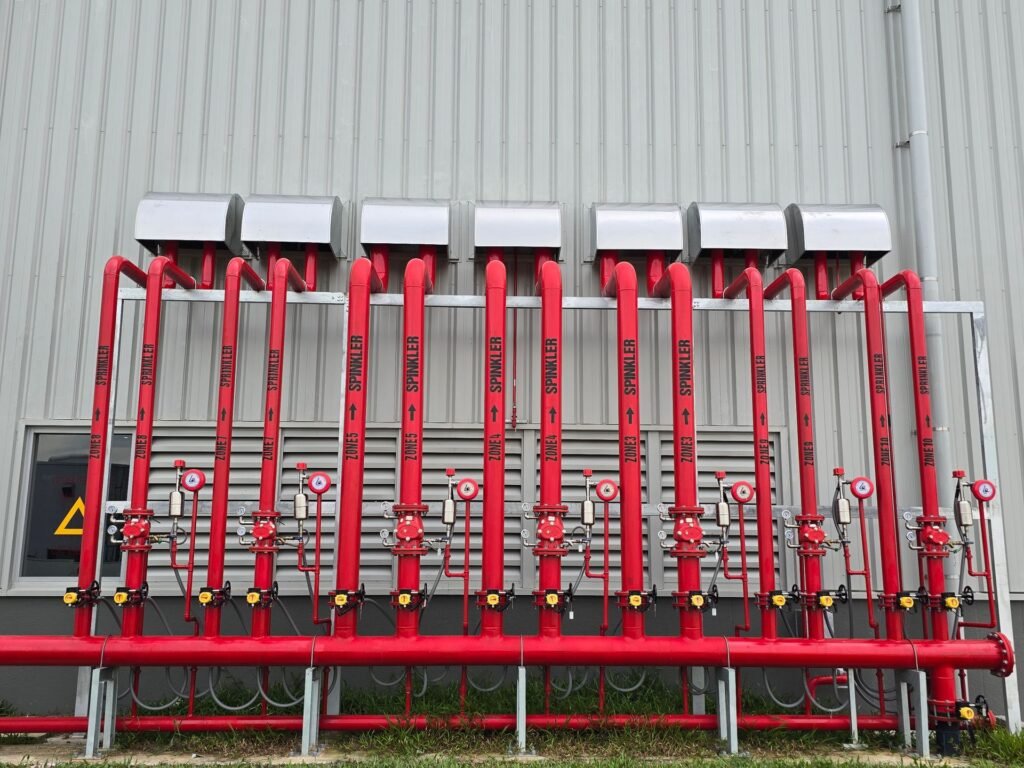
Selecting a Fire Suppression System in Saudi Arabia requires more than identifying a fire extinguishing agent or purchasing suppression equipment. Building owners, facility managers, electrical engineers, and main contractors must consider the hazard, the protected space, equipment sensitivity, applicable fire safety requirements, operational constraints, and the documentation required for project approval.
These considerations become particularly important in electrical rooms, control cabinets, server environments, industrial facilities, and airport infrastructure. A fire involving electrical equipment can interrupt essential operations, damage critical assets, and create risks that extend beyond the original point of ignition.
Different applications require different protection strategies. A clean-agent system intended for a defined room has a different design scope from a localized tube detection system protecting an electrical panel. Neither should be selected without a suitable hazard assessment and review by qualified fire protection professionals.
This guide explains the principal considerations for commercial and industrial facilities seeking fire suppression system installation in Saudi Arabia, including system options, airport project coordination, regulatory considerations, and quotation preparation.
For businesses planning a project, Advanced Times Company’s fire suppression system supply and installation service provides a relevant starting point for discussing project requirements.
Table of Contents
- 1. Understanding Fire Suppression Systems in Saudi Arabia
- 2. Electrical Room Fire Suppression Systems
- 3. Comparing FM200, Novec, and Tube Detection
- 4. Airport Fire Suppression and Electrical Infrastructure
- 5. Saudi Compliance and Project Planning
- 6. Climate, Logistics, and Scheduling Considerations
- 7. Choosing a Contractor and Requesting a Quotation
- 8. Who Should Reconsider a Proposed System?
- 9. Frequently Asked Questions
- 10. Discuss Your Project with Advanced Times Company
1. Understanding Fire Suppression Systems in Saudi Arabia
A fire suppression system is an engineered arrangement intended to detect, control, or extinguish a fire within a defined area or hazard. Depending on the application, it may use a gaseous agent, another extinguishing medium, or a localized arrangement designed for specific equipment.
The appropriate solution depends on the building’s occupancy, the materials present, the potential ignition sources, the equipment that requires protection, and the applicable design requirements.
Why system selection matters
Commercial and industrial facilities contain different types of fire hazards. An office building, a manufacturing plant, an electrical distribution room, and an airport operations facility do not necessarily have identical protection requirements.
For example:
- Commercial buildings: Protection must be considered alongside occupancy, evacuation, and the building’s wider fire safety arrangements.
- Industrial facilities: Electrical equipment, machinery, process hazards, and combustible materials can influence the protection strategy.
- Data and telecommunications rooms: Equipment sensitivity and operational continuity may make the consequences of residue or water exposure particularly important.
- Electrical rooms: Electrical distribution equipment and associated infrastructure require a hazard-specific assessment.
- Airport facilities: Fire protection must be coordinated with operational requirements, project permissions, and relevant authorities.
A suppression system should form part of the overall fire safety strategy rather than be treated as an isolated equipment purchase.
Saudi Arabia’s building regulations include the Saudi Fire Protection Code, SBC 801, which establishes fire protection requirements for buildings and facilities. The provisions applicable to a specific project must be determined by qualified professionals and the relevant authorities.
2. Electrical Room Fire Suppression Systems
An Electrical Room Fire Suppression System must be evaluated against the actual hazards in the room and the function of the equipment installed there.
Electrical rooms may contain distribution boards, switchgear, transformers, control equipment, cable systems, and other components that support building operations. Potential ignition sources and the consequences of equipment failure vary considerably between installations.
Room-level fire protection
A room-level system is designed around the protected space and its defined fire hazard. Depending on the building and approved design, the wider protection strategy may involve detection, alarms, suppression, ventilation interfaces, and other fire safety measures.
For clean-agent systems, the design assessment may need to consider:
- The dimensions and configuration of the protected enclosure.
- The type of fire hazard and equipment present.
- The agent and system configuration under consideration.
- Openings, ventilation, and enclosure integrity where relevant.
- Occupancy and personnel safety.
- Interfaces with detection, alarms, and other building systems.
- Inspection, maintenance, and operational requirements.
The suitability of a particular suppression agent cannot be established from room size alone. A qualified engineer must evaluate the complete hazard and the applicable requirements.
Electrical room versus electrical panel protection
A common procurement mistake is to treat protection for an electrical room and protection for an individual electrical panel as interchangeable.
They address different scopes.
A room-level system is assessed against the hazards and requirements of the defined room. A localized panel system is assessed against the specific equipment enclosure and its internal fire risks.
A facility may require one approach, the other, or coordinated protection arrangements. This decision depends on the risk assessment and approved design.
For example, a localized system may be considered for a control cabinet containing critical components, while the surrounding room remains subject to its own fire detection and protection requirements.
Important: Localized equipment protection should not automatically be treated as a replacement for the building’s required fire alarm, evacuation, compartmentation, or wider fire suppression provisions.
Fire suppression for electrical panels
A Fire Suppression System for Electrical Panels may use a tube detection arrangement designed around the protected enclosure.
The general principle is that a heat-sensitive detection tube responds to a fire condition and initiates suppression according to the system configuration. Some arrangements discharge the agent through the activated tube, while others use separate discharge outlets.
The correct configuration depends on the specific system, manufacturer requirements, hazard characteristics, and approved engineering design.
Advanced Times Company publishes a dedicated tube detection fire suppression system service for Saudi Arabia, which is relevant for enquiries involving electrical panels and localized equipment protection.
3. Comparing FM200, Novec, and Tube Detection
A Clean Agent Fire Suppression System in Saudi Arabia may be considered where the hazard assessment identifies a suitable application and the approved design supports its use.
Clean-agent systems are often evaluated for areas containing sensitive electronic equipment because they can suppress certain fires without leaving the residue associated with some other extinguishing media.
However, clean-agent systems are not interchangeable in every application. The choice must account for the specific agent, system design, personnel safety, environmental considerations, availability, and applicable project requirements.
System options comparison
| Option | General application context | Key considerations | What to confirm when requesting a quotation |
|---|---|---|---|
| FM200 clean-agent system | Certain electrical rooms, server rooms, and other defined equipment spaces | Hazard suitability, design requirements, enclosure characteristics, personnel safety, and agent availability | Proposed application, equipment scope, design basis, cylinder requirements, and applicable documentation |
| Novec 1230 clean-agent system | Certain sensitive equipment spaces where a compatible clean-agent design is appropriate | Agent suitability, system compatibility, environmental considerations, supply arrangements, and current project requirements | Exact agent and system specification, component compatibility, supply availability, and maintenance arrangements |
| Tube detection fire suppression | Individual electrical panels, cabinets, and other suitable enclosed equipment | Localized hazard, enclosure configuration, detection arrangement, agent compatibility, and manufacturer requirements | Protected equipment, system configuration, supplied components, installation scope, and maintenance requirements |
| Wider building fire protection arrangements | Buildings and facilities requiring coordinated fire safety provisions | Occupancy, fire strategy, applicable codes, alarm interfaces, evacuation, and other required systems | Overall project scope, interfaces, documentation, approval responsibilities, and testing requirements |
This table provides general selection context, not an engineering recommendation for any specific building.
FM200 fire suppression systems
FM200 is a gaseous clean-agent fire suppression technology used in certain applications involving sensitive equipment.
A project assessment must establish whether the proposed system is suitable for the hazard and occupancy. Design considerations include the protected volume, agent quantity, enclosure conditions, discharge arrangements, personnel safety, and required interfaces.
Advanced Times Company lists FM200 gas cylinders among its products.
The availability of a product does not, by itself, establish that it is suitable for every electrical room or that a particular installation meets all project requirements.
Novec clean-agent systems
Novec 1230 has been used in clean-agent fire suppression applications involving sensitive equipment.
For a new project or system replacement, the project team should confirm the exact agent specification, system compatibility, supplier availability, applicable environmental requirements, and the manufacturer’s current technical documentation.
The product name alone is insufficient to determine suitability.
Advanced Times Company lists Novec gas cylinders on its website.
Tube detection systems
Tube detection systems are generally evaluated for localized hazards within compatible enclosures, including certain electrical panels and control cabinets.
They differ from room-level clean-agent systems in their intended protection scope and detection arrangement. A localized system may help address a specific equipment hazard, but it does not automatically provide protection for the surrounding room or building.
For more detailed product and application information, consult the company’s tube detection fire suppression service.
How should a facility choose?
There is no universally suitable system for every electrical room.
The decision should be based on a documented assessment of the hazard, the protected equipment, the room or enclosure characteristics, applicable regulations, personnel safety, and the complete fire protection strategy.
The final selection should be reviewed by a qualified fire protection engineer and coordinated with the relevant authority where required.
4. Airport Fire Suppression and Electrical Infrastructure
An Airport Fire Suppression System project requires careful coordination because airports contain operationally critical facilities and often have additional site-access, security, documentation, and work-permit requirements.
Electrical rooms may support lighting, communications, security equipment, building services, operational systems, and other essential infrastructure. The consequences of a fire can therefore extend beyond direct equipment damage.
Airport electrical room fire suppression
An airport electrical room fire protection assessment should consider the specific equipment and operational function of the protected area.
Depending on the project, the scope may involve:
- Electrical distribution and control equipment.
- Communications or monitoring infrastructure.
- Critical equipment rooms.
- Detection and suppression interfaces.
- Existing building fire protection systems.
- Maintenance and emergency access requirements.
These are examples of possible project considerations, not a claim that every airport requires the same suppression arrangement.
Coordination before work begins
Airport projects may require additional coordination with airport facilities management, the main contractor, consultants, security personnel, and the relevant fire safety authorities.
Before requesting a quotation, the project team should establish:
1. Site access requirements
Confirm access permissions, security procedures, equipment delivery arrangements, and any restrictions affecting contractors.
2. Work permits and operational restrictions
Determine whether the project requires formal work permits, restricted working windows, or specific procedures for working in operational areas.
3. Shutdown and impairment planning
Where existing fire protection systems or electrical services could be affected, the work must be coordinated through the authorized project procedures. Any system impairment should be managed by responsible personnel in accordance with applicable requirements.
4. Documentation and inspection
Clarify which drawings, technical submittals, test records, handover documents, and authority reviews are required.
5. Interface coordination
Suppression systems may need to interact with alarms, monitoring systems, ventilation controls, or other building services. The project scope should identify the responsible parties for these interfaces.
Airport-related projects may also have additional government or airport-operator review requirements. The applicable requirements should be confirmed for the specific facility and contract.
A contractor’s general capability in fire suppression does not automatically establish approval to undertake work at a particular airport. Required registrations, permissions, and project approvals must be verified separately.
5. Saudi Compliance and Project Planning
Fire suppression system installation in Saudi Arabia must be planned around the requirements applicable to the building, occupancy, hazard, and project.
The Saudi Fire Protection Code, SBC 801, addresses protection against fire and explosion hazards, life safety, property protection, and related design and inspection requirements. The Saudi Civil Defense also publishes guidance concerning fire protection procedures and regulatory compliance.
What should the project team confirm?
Before selecting equipment or awarding a contract, confirm the following.
Applicable codes and regulations
Identify the Saudi Building Code provisions and other applicable requirements relevant to the specific facility and scope.
Authority requirements
Determine the role of the Saudi Civil Defense and any other authority having jurisdiction over the project. The approval process may vary according to the building, occupancy, and project circumstances.
Design responsibility
Clarify who is responsible for preparing, reviewing, and submitting the fire protection design.
Equipment documentation
Confirm the technical data sheets, specifications, compatibility information, and other documents required for the proposed system.
Installation and testing scope
Establish the contractual responsibilities for installation, inspection, functional testing, commissioning, and handover.
Maintenance arrangements
Confirm the inspection schedule, service responsibilities, spare-parts availability, and manufacturer recommendations applicable to the installed system.
Standards are not the same as company certification
International standards may be relevant to particular system types, and a qualified engineer may identify applicable NFPA or other technical references during design.
However, citing a standard does not establish that a contractor holds a particular certification, that every component is approved to a particular listing, or that a project has received regulatory approval.
These matters must be verified using the relevant documents and authorities.
Advanced Times Company’s website describes its fire suppression and tube detection services. Any project-specific compliance claim should be supported by the actual technical documentation, applicable approvals, and evidence required for that project.
Why approval planning matters
Regulatory review should not be treated as an administrative step to resolve after installation.
The project team should establish the applicable requirements early enough to coordinate the design, procurement, installation, testing, and handover documentation.
This is especially important when the fire protection scope forms part of a larger construction or refurbishment contract.
6. Climate, Logistics, and Scheduling Considerations
Saudi Arabia’s regional conditions and project schedules can affect procurement, construction planning, equipment storage, and maintenance arrangements.
These factors do not automatically determine which suppression agent should be selected. They should instead be evaluated alongside the technical requirements of the installation.
Riyadh: heat and dust exposure
Projects in Riyadh may need to account for high outdoor temperatures, dust exposure, and the conditions in which equipment is transported, stored, and installed.
The design and installation teams should confirm applicable equipment environmental ratings, storage requirements, enclosure conditions, and maintenance needs.
Dust management is also relevant to the wider facility fire safety strategy, particularly where electrical equipment and ventilation systems are involved.
Jeddah: coastal environmental conditions
For projects in Jeddah, the team should consider the actual site’s exposure to humidity, coastal air, and potentially corrosive environmental conditions.
Equipment selection, material compatibility, storage, and inspection requirements should reflect the project environment and manufacturer guidance.
Coastal exposure alone is not a reason to select one clean agent over another.
Dammam and the Eastern Province: industrial requirements
Industrial facilities in Dammam and the Eastern Province may have additional considerations arising from process equipment, machinery, electrical infrastructure, or the nature of the surrounding industrial environment.
The hazard assessment should reflect the actual process and equipment rather than rely on a generic industrial classification.
Logistics across the Kingdom
For projects outside Riyadh, procurement planning should account for equipment availability, delivery schedules, site access, storage, and coordination with other trades.
The quotation should clearly identify the delivery location and the responsibilities included in the proposed scope.
Ramadan, Hajj, and operational schedules
Construction schedules can be affected by public holidays, reduced working hours, traffic, site restrictions, and seasonal operational requirements.
The impact varies by city, facility, contractor, and project.
For airport facilities and other continuously operating sites, project managers should confirm permitted working windows and coordinate shutdowns or potentially disruptive activities with the responsible operator.
Practical recommendation: Agree on the programme, access requirements, procurement milestones, testing arrangements, and handover responsibilities before committing to a completion date.
7. Choosing a Contractor and Requesting a Quotation
Choosing a fire suppression contractor should involve a review of technical suitability, scope clarity, regulatory responsibilities, and the evidence available to support the proposed solution.
A low initial quotation may not represent the same scope as a more comprehensive proposal. Conversely, a larger scope should be justified by documented project requirements rather than vague claims.
Contractor evaluation checklist
When assessing fire suppression system contractors in Saudi Arabia, confirm:
- Whether the contractor’s stated service matches the required application.
- Who is responsible for engineering design and technical submissions.
- Whether the proposed equipment is identified clearly.
- Which approvals, reviews, and documentation are required.
- Whether installation, testing, and commissioning are included.
- How interfaces with existing fire alarm and building systems will be handled.
- What inspection and maintenance responsibilities apply after handover.
- Which company credentials, product documents, and approvals can be verified for the specific project.
- Whether the proposed programme reflects site access and operational constraints.
The evaluation should be based on verifiable documentation rather than unsupported claims.
What affects project pricing?
Advanced Times Company does not publish a verified price list for the service covered by this article. A reliable project quotation therefore requires the actual scope and technical requirements.
Factors that may influence the quotation include:
| Factor | Information to provide |
|---|---|
| Facility and location | City, building type, site access, and operating conditions |
| Protected area | Room dimensions or details of the equipment enclosure |
| Hazard | Equipment type, likely fire hazards, and operational importance |
| Proposed scope | Supply only, supply and installation, or a wider project package |
| Equipment | Required system type, cylinders, components, and associated interfaces |
| Existing systems | Available drawings, existing detection arrangements, and integration requirements |
| Compliance | Required design submissions, reviews, testing, and handover documentation |
| Schedule | Target dates, access restrictions, shutdown windows, and delivery requirements |
| Maintenance | Inspection, servicing, and support expectations after installation |
These factors provide a framework for requesting a comparable quotation. They are not a substitute for engineering assessment.
How to request an accurate quotation
Prepare the available drawings, equipment schedules, room or enclosure details, existing system information, project location, and required completion date.
Clearly state whether the request concerns an entire electrical room, an individual electrical panel, or another defined hazard.
Identify any airport operator requirements, work permits, access restrictions, or existing system interfaces that could affect the scope.
Ask the contractor to distinguish the proposed equipment supply, installation responsibilities, testing, documentation, and maintenance provisions.
If essential technical information is unavailable, arrange for the project requirements to be assessed before relying on a fixed scope.
Request a project quotation: Contact Advanced Times Company on +966 50 393 4758 or email shamshul@advancedtimescompany.com.
The company can be approached to discuss the required scope and determine what information is needed to evaluate the enquiry.
8. Who Should Reconsider a Proposed System?
Not every fire protection concern should begin with purchasing a dedicated gaseous suppression system.
This distinction helps prevent unsuitable procurement decisions and supports a more complete fire safety strategy.
Small residential requirements
A homeowner seeking basic domestic fire safety may need to begin with the building’s applicable requirements, appropriate alarms, suitable portable extinguishers, evacuation arrangements, and guidance from a qualified professional.
A dedicated commercial clean-agent system may not be appropriate for that need.
The correct response depends on the property, its hazards, and the applicable regulations.
Facilities without a defined hazard assessment
If the building owner cannot identify the protected area, equipment, hazard, or applicable design requirements, selecting an agent prematurely may create avoidable procurement and compliance problems.
The first step should be to establish the requirements with a qualified fire protection professional.
Projects requiring authority clarification
Where the applicable approval route, existing compliance status, or required fire protection scope is unclear, consult the relevant authority and qualified engineering professionals before committing to equipment procurement.
Projects seeking a guaranteed outcome
No suppression system should be represented as eliminating every possible fire risk.
System performance depends on appropriate design, correct application, installation, maintenance, operating conditions, and the hazards involved.
Responsible procurement requires a realistic understanding of the system’s intended function and limitations.
9. Frequently Asked Questions
1. What type of fire suppression system may be suitable for an electrical room in Saudi Arabia?
The suitable system depends on the electrical equipment, hazard assessment, room characteristics, personnel safety, applicable codes, and the wider fire protection strategy. Clean-agent systems may be considered for certain sensitive equipment environments, but the final selection must be made by qualified professionals in accordance with applicable requirements.
2. What is the difference between room-level suppression and electrical panel suppression?
Room-level suppression is designed around a defined room and its hazards. Electrical panel suppression is designed around a specific equipment enclosure. The two arrangements have different protection scopes, and localized panel protection does not automatically replace the building’s wider fire protection requirements.
3. What is the difference between FM200 and Novec 1230?
Both have been used as clean agents in certain fire suppression applications. They differ in their agent characteristics, technical specifications, and system requirements. Suitability depends on the actual hazard, applicable regulations, product availability, environmental considerations, and the approved design.
4. Are clean-agent fire suppression systems required in every electrical room?
No universal answer applies to every electrical room. Requirements depend on the building, occupancy, hazards, applicable Saudi regulations, and approved project design. A qualified fire protection engineer should establish the requirements with the relevant authority.
5. What approvals and regulations should be considered in Saudi Arabia?
The project team should identify the applicable Saudi Building Code provisions, including relevant fire protection requirements, and establish the role of Saudi Civil Defense and any other authority having jurisdiction. Required design reviews, documentation, inspections, and approvals must be confirmed for the particular project.
6. What information should be provided when requesting a quotation?
Provide the project location, building or equipment type, protected area dimensions, available drawings, known hazards, existing system details, required scope, project schedule, and applicable access or approval requirements. This helps the contractor assess the information needed to prepare a meaningful proposal.
7. What affects the timeline for a commercial fire suppression project?
The timeline may depend on design requirements, approvals, equipment availability, procurement, site access, coordination with other trades, installation conditions, testing, and handover documentation. Airport and continuously operating facilities may require additional scheduling coordination.
8. How should airport fire suppression projects be coordinated?
The project should identify the airport operator’s requirements, security and access arrangements, work permits, shutdown restrictions, system interfaces, documentation, and approval responsibilities before work begins. Any operational restrictions must be managed through the responsible project’s authorized procedures.
9. How often should a fire suppression system be inspected?
Inspection and maintenance frequency depends on the system type, applicable requirements, manufacturer recommendations, and the facility’s maintenance programme. The responsible facility team should maintain the required inspection records and arrange servicing by appropriately qualified personnel.
10. Does a tube detection system replace the building’s wider fire protection arrangements?
Not automatically. A tube detection system is generally intended for a defined localized hazard. The facility’s wider requirements for alarms, evacuation, compartmentation, and building-level fire protection must be assessed separately.
10. Discuss Your Fire Suppression Project with Advanced Times Company
Selecting a Fire Suppression System in Saudi Arabia requires a clear understanding of the hazard, protected equipment, applicable regulations, and project responsibilities.
For electrical rooms and critical equipment, the distinction between room-level protection and localized panel suppression is particularly important. Airport projects also require careful coordination of access, operational constraints, documentation, and approval requirements.
Advanced Times Company for General Contracting provides fire suppression system supply and installation services and lists FM200 cylinders, Novec cylinders, and related fire protection components on its website.
For a commercial, industrial, electrical room, or airport-related enquiry, prepare the available project details and discuss the proposed scope with the company.
Telephone: +966 50 393 4758
Email: shamshul@advancedtimescompany.com
Address: Office 14/A, 2nd Floor, Rasheed & Othaim Center, Malaz, Riyadh, Saudi Arabia
Visit the Advanced Times Company contact page to submit an enquiry.