
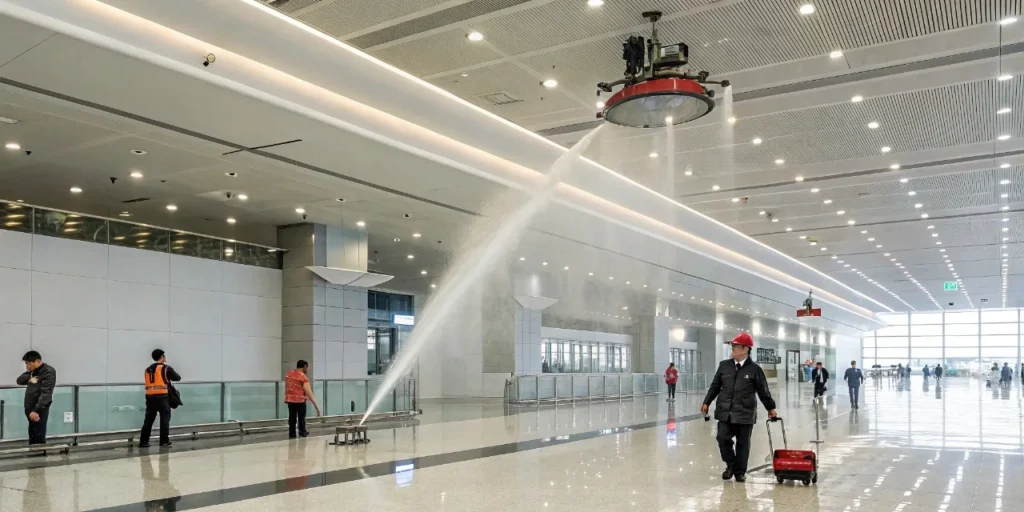
Airports depend on electrical infrastructure, communications equipment, control systems and technical rooms to support safe, continuous operations. A fire affecting one of these spaces can damage equipment, interrupt essential services and create significant operational challenges.
Airport equipment room fire suppression therefore requires a structured approach that considers the room’s purpose, installed equipment, potential ignition sources, occupancy, ventilation and applicable fire safety requirements.
For airport developers, facility managers, MEP contractors and procurement teams in Saudi Arabia, choosing a suitable protection strategy involves more than selecting a suppression agent. The system must form part of an appropriately engineered fire protection design and satisfy the requirements of the relevant authorities and airport operator.
Advanced Times Company for General Contracting provides fire suppression system supply and installation services, along with related products including FM200 and Novec gas cylinders and tube detection fire suppression systems. These existing services provide a relevant starting point for discussing equipment-room protection without assuming that every system is appropriate for every airport application. شركة الأزمنة المتقدمة للمقاولات العامة –
Table of Contents
- 1. Understanding Airport Equipment-Room Fire Risks
- 2. Why Careful Planning Matters
- 3. Fire Suppression Options
- 4. Saudi Compliance and Airport Approvals
- 5. Project Execution Across Saudi Arabia
- 6. Supplier Selection and Quotation Checklist
- 7. When Suppression May Not Be the First Step
- 8. Advanced Times Company Services
- 9. Frequently Asked Questions
1. Understanding Airport Equipment-Room Fire Risks
Airport equipment rooms are not all alike. An electrical switchroom, communications room, security control room and specialist equipment enclosure may contain different electrical loads, materials, ventilation arrangements and operational requirements.
A suitable fire protection assessment should begin by identifying what the room contains and how a fire could develop.
Electrical equipment and switchrooms
Electrical distribution equipment, switchgear, control panels and associated cabling may be exposed to overheating, electrical faults or other ignition sources. The risk depends on the installation, equipment condition, operating environment and maintenance arrangements.
Protection planning should consider the equipment’s configuration, electrical hazards, room boundaries and the fire detection arrangements already in place.
Communications and control rooms
Communications equipment and operational control systems can be important to airport services. A fire affecting these rooms may cause consequences beyond the immediate physical damage.
Where sensitive electronic equipment is present, the design team should evaluate whether a suppression approach that avoids leaving conventional firefighting residue is appropriate. This does not mean that a clean-agent system is automatically the correct solution; the complete hazard assessment remains essential.
Enclosures and specialised equipment
Some equipment hazards are concentrated inside cabinets, machinery enclosures or other relatively small spaces. In such circumstances, an engineered localised detection and suppression arrangement may warrant assessment.
The key distinction is between protecting an individual enclosure and protecting the complete room. These are different design problems and should not be treated as interchangeable.
2. Why Airport Equipment Room Fire Suppression Requires Careful Planning
An effective protection strategy must account for people, equipment, the building and ongoing operations.
First, life safety remains the priority. Suppression-system design must account for occupancy, evacuation arrangements, warning systems and the characteristics of the proposed agent. A system should not be selected solely because it is described as clean or suitable for electronics.
Second, equipment protection requires an appropriate hazard assessment. Electrical installations, combustible materials and the room’s physical configuration can influence the required protection measures.
Third, room integrity may be important. Where a total-flooding clean-agent system is considered, the engineering assessment must address whether the protected enclosure can maintain the conditions required by the design. Doors, penetrations, ventilation openings and changes to the room can affect performance.
Fourth, integration matters. Detection, alarms, suppression controls and other building safety systems must be coordinated according to the approved design. Existing systems and operational interfaces should be documented before changes are undertaken.
Finally, airport operations introduce additional constraints. Work may require security clearance, access restrictions, isolation planning and coordination with airport representatives. These requirements should be identified before the installation schedule is committed.
The appropriate approach is therefore an engineered assessment followed by the required design review, installation, testing, documentation and handover.
3. Fire Suppression Options for Airport Equipment Rooms
Several technologies may be relevant to equipment-room protection. Their suitability depends on the hazard, protected volume, equipment configuration, occupancy and applicable requirements.
The following comparison is intended to support preliminary discussions, not replace engineering design.
Comparison of system options
| Option | Typical application to assess | Important considerations | What to confirm in a quotation |
|---|---|---|---|
| Clean-agent room suppression, including FM-200-based systems | Suitable enclosed electrical, communications or control rooms | Room integrity, agent requirements, occupancy, detection, ventilation and system interfaces | Design basis, equipment scope, calculations, testing and handover documentation |
| Novec-related clean-agent systems | Applications where a compatible clean-agent approach is specified and available | Exact agent and product specification, availability, system compatibility and project requirements | Exact product offered, specification, component compatibility and applicable approvals |
| Tube-based detection and suppression | Suitable individual enclosures or concentrated equipment hazards | Enclosure configuration, detection coverage, hazard characteristics and the manufacturer’s design limitations | Protected equipment, system scope, compatible components and required documentation |
| Building-wide fire protection systems | Broader building and fire-compartment protection | Occupancy classification, building design, evacuation and coordination with other systems | Scope boundaries, interfaces, drawings and responsible parties |
These options are not direct substitutes for one another. A room-based clean-agent system addresses a different protection scope from an enclosure-level tube-based arrangement.
Clean-agent suppression considerations
FM-200 is a clean-agent suppression technology associated with equipment-room applications. Advanced Times Company publishes FM200 gas cylinders and fire suppression services relevant to this category. شركة الأزمنة المتقدمة للمقاولات العامة –
The engineering team must determine whether a particular system is appropriate for the actual hazard. Relevant factors include the room volume, equipment arrangement, enclosure integrity, detection and release arrangements, occupancy and the governing project requirements.
The same principle applies to Novec-related systems. The exact agent, product specification, system compatibility and current availability must be confirmed during procurement. A product name alone does not establish suitability or regulatory acceptance.
Tube detection and suppression
Tube-based detection and suppression may be considered for suitable enclosed equipment where the system’s design and application limitations permit its use.
This approach differs from protecting an entire room with a clean-agent system. The detection method, protected area, equipment configuration and suppression coverage must be established by a qualified fire protection professional.
Advanced Times Company publishes a dedicated tube detection fire suppression service page. Its existence establishes a relevant service offering, but it does not establish that a particular tube-based system is approved for a particular airport installation. شركة الأزمنة المتقدمة للمقاولات العامة –
How should the final system be selected?
The final decision should follow a documented engineering assessment. Consider:
- The equipment and electrical hazards present.
- Whether the protected area is an entire room or an individual enclosure.
- Occupancy and personnel safety.
- Room integrity and ventilation.
- Detection and alarm integration.
- Applicable authority and airport-operator requirements.
- Equipment compatibility and ongoing maintenance arrangements.
A qualified fire protection engineer should assess these factors before any specific system is recommended.
4. Saudi Compliance and Airport Approval Considerations
Airport fire protection projects require careful coordination between the project team, the relevant authorities and the airport operator.
In Saudi Arabia, the applicable Saudi Building Code provisions, including relevant fire protection requirements, and Saudi Civil Defense requirements must be assessed for the specific project. Airport-specific requirements may introduce additional reviews, documentation and work controls.
The exact requirements depend on the airport, facility, project scope and authority having jurisdiction. A contractor should not assume that approval for an ordinary commercial building automatically satisfies the requirements of an airport installation.
What project teams should establish
Applicable codes and design requirements: Identify the provisions governing the protected space, its occupancy, fire protection arrangements and any interfaces with existing systems.
Authority and airport-operator reviews: Establish which drawings, technical submissions and approvals must be obtained before work begins. Airport stakeholders may have separate review and access requirements.
Design documentation: Confirm that the proposed scope includes the necessary drawings, equipment specifications, design calculations and supporting technical documents.
Installation permissions: Determine whether security clearance, work permits, equipment movement approvals or other site-specific permissions are required.
Testing and handover: Establish the required inspection, functional testing, commissioning records, operating instructions and maintenance documentation.
Existing system coordination: Identify any necessary changes to existing fire alarms, suppression controls or other building services. Work affecting live systems must be coordinated with the responsible parties under the approved procedures.
The Riyadh Airports Tenant Fit-Out Manual illustrates why airport project coordination matters: it addresses contractor responsibilities, safety requirements and airport approval processes. Its provisions relate to the relevant airport context and should not be treated as a universal specification for every airport in Saudi Arabia. Riyadh Airports
Why compliance must be confirmed early
Late identification of an approval requirement can affect procurement, access arrangements, project sequencing and handover.
Before awarding the work, the building owner or main contractor should obtain clarity on:
- The authority having jurisdiction and airport approval pathway.
- The required design and technical submissions.
- The responsibilities of the designer, installer and other contractors.
- The required testing and handover evidence.
- The process for managing changes to the approved design.
No contractor should promise regulatory acceptance before the required review has taken place.
5. Airport Fire Suppression Project Execution Across Saudi Arabia
Saudi Arabia’s climate, geographic scale and airport operating environments can influence project planning. These considerations should inform the execution plan without replacing the underlying engineering requirements.
Riyadh: Heat and dust management
In Riyadh, high outdoor temperatures and dust exposure can be relevant to equipment handling, storage, site access and maintenance planning.
Project teams should verify the specified environmental operating limits of the proposed equipment and arrange suitable storage and protection during transportation and installation. Dust ingress and contamination should also be considered where they affect the equipment or the protected environment.
These factors do not, by themselves, determine which suppression agent should be selected.
Jeddah: Coastal environmental conditions
Jeddah’s coastal environment makes it sensible to assess humidity, corrosion exposure and equipment-storage conditions where relevant.
The project specification should address the actual installation environment, including any required environmental protection for components. The design team should not assume that every product has the same environmental tolerances.
Dammam and the Eastern Province
For projects in Dammam and the wider Eastern Province, environmental conditions, industrial interfaces and site logistics should be assessed according to the facility.
Where airport projects form part of a wider industrial or infrastructure programme, the contractor should coordinate delivery schedules, site access and technical interfaces with the principal contractor and relevant stakeholders.
Scheduling and operational continuity
Airport works can be constrained by security procedures, operational access windows, shutdown restrictions and permit requirements.
Ramadan and Hajj-season periods may also affect workforce availability, transport arrangements or access planning for some projects, depending on location and operational demand. These effects should be confirmed with the project stakeholders rather than assumed.
A practical schedule should identify:
- Site access and security requirements.
- Material submittal and approval lead times.
- Equipment procurement and delivery dependencies.
- Permitted work windows.
- Any approved shutdown or isolation arrangements.
- Testing, inspection and handover milestones.
The objective is to establish a realistic, approved work programme before committing to a completion date.
6. How to Compare Suppliers and Request a Quotation
An airport equipment-room fire suppression quotation should be based on a clearly defined scope. Comparing proposals solely by equipment names or cylinder quantities can overlook important engineering and project-delivery differences.
Information to provide when requesting a quotation
Use this checklist to prepare the initial enquiry.
1. Project and site details
- Airport and project location.
- Name or description of the building or technical area.
- New installation, replacement, extension or modification.
- Project stage and expected procurement requirements.
2. Room and equipment information
- Available room dimensions and relevant drawings.
- Description of electrical, communications or control equipment.
- Existing fire detection and suppression arrangements.
- Relevant room openings, ventilation and enclosure information.
- Any known equipment or environmental constraints.
3. Required scope
- Design and technical documentation requirements.
- Equipment supply requirements.
- Installation and system integration responsibilities.
- Testing, commissioning and handover expectations.
- Maintenance and ongoing support requirements, if included.
4. Compliance and coordination
- Applicable project specifications.
- Known authority and airport-operator requirements.
- Required technical submittals.
- Site access, security and permit constraints.
- Interfaces with the main contractor and other building services.
5. Commercial and scheduling requirements
- Project location and delivery arrangements.
- Required completion milestones.
- Tender submission deadline.
- Quotation validity and commercial conditions.
- Scope exclusions and client-supplied items.
Understanding the main scope options
| Commercial scope | What it may include | What to clarify |
|---|---|---|
| Equipment supply | Specified cylinders or components | Exact specification, compatibility, quantities and documentation |
| Supply and installation | Agreed equipment and installation work | Design responsibility, site works, integration and testing |
| Broader project package | Multiple coordinated fire protection activities | Scope boundaries, interfaces, approval responsibilities and handover requirements |
These categories describe general procurement approaches, not a claim that every listed package is offered under identical terms by Advanced Times Company.
What affects project pricing?
There is no published Advanced Times Company price for this airport-specific application in the information reviewed. A responsible quotation should be based on the actual project scope rather than an invented online estimate.
The principal cost drivers may include:
- Room dimensions and protected volume.
- Hazard type and equipment configuration.
- Selected system and required components.
- Existing infrastructure and system interfaces.
- Installation access and site constraints.
- Technical documentation and testing requirements.
- Project location, transport and delivery arrangements.
- Programme requirements and approved work windows.
To request a project-specific quotation, send the available drawings, equipment details, required scope and project location to Advanced Times Company.
For project enquiries, call +966 50 393 4758 or email shamshul@advancedtimescompany.com.
7. When Airport Equipment-Room Suppression May Not Be the First Step
Not every fire safety concern should begin with a request for a new suppression system.
When the hazard has not been established: A preliminary assessment may be needed to identify the ignition sources, combustible materials and appropriate protection objectives before specifying equipment.
When the room’s wider fire strategy is unclear: The project team may need to review the building’s overall fire protection design, compartmentation, detection, evacuation and existing suppression arrangements before deciding on a room-specific solution.
When the proposed technology does not match the hazard: A product selected because it is commonly used in electrical rooms may still be inappropriate for the actual equipment, occupancy or enclosure.
When authority requirements are unresolved: The project owner should establish the relevant approval pathway before committing to equipment or installation arrangements.
When the requirement falls outside the project scope: Small residential or unrelated low-risk requirements may not warrant an airport-oriented procurement process. Such requests should be assessed against their actual needs and the appropriate service scope.
These considerations are not reasons to delay necessary safety measures. They are reasons to establish the correct problem, responsible parties and compliance requirements before selecting a solution.
8. Advanced Times Company Services for Fire Suppression Projects
Advanced Times Company for General Contracting provides fire suppression system supply and installation services in Saudi Arabia. Its published product range includes FM200 and Novec gas cylinders, Tyco and Kidde components, Fike solenoids, nozzles, pressure switches, manual releases and related equipment. The company also publishes a dedicated tube detection fire suppression service. شركة الأزمنة المتقدمة للمقاولات العامة –
For an airport equipment-room enquiry, the appropriate starting point is a review of the actual project requirements and the company’s relevant service scope.
Useful next steps include:
- Provide the project location and equipment-room description.
- Share available drawings and technical specifications.
- Explain whether the requirement concerns a complete room or an individual enclosure.
- Identify known airport-operator and authority requirements.
- Request clarification of the proposed scope, exclusions and handover documentation.
The company also publishes a wider range of general contracting services, including civil work, electrical emergency doors and glass work. Any additional work should be defined separately and confirmed against the actual project requirements.
For more information, visit the company’s fire suppression system service page or contact the company directly.
Advanced Times Company for General Contracting
Passion to Protect
- Telephone: +966 50 393 4758
- Email: shamshul@advancedtimescompany.com
- Location: Malaz, Riyadh, Saudi Arabia
9. Frequently Asked Questions
1. What is airport equipment-room fire suppression?
Airport equipment-room fire suppression is a fire protection approach designed around the hazards and operating requirements of a technical room or equipment enclosure within an airport. The appropriate solution depends on the equipment, room configuration, occupancy, applicable requirements and wider fire safety strategy.
2. Which fire suppression systems may be considered for airport electrical rooms?
Clean-agent suppression systems, including suitable FM-200-based systems, may be evaluated for certain enclosed electrical or control rooms. Tube-based detection and suppression may be considered for appropriate equipment enclosures. The final selection requires a qualified engineering assessment and confirmation of applicable project requirements.
3. Is FM-200 suitable for every airport equipment room?
No. Suitability depends on the hazard, protected volume, room integrity, occupancy, system specification and applicable requirements. A qualified fire protection engineer should determine whether an FM-200-based system is appropriate for the specific application.
4. How does tube detection differ from a room-based clean-agent system?
Tube-based systems are designed for particular detection and suppression applications, potentially involving suitable equipment enclosures. A room-based clean-agent system is designed to protect a defined room or protected volume. Their scope, design assumptions and applications differ, so they should not be treated as interchangeable.
5. Which approvals are needed for airport fire suppression work in Saudi Arabia?
The applicable requirements depend on the airport, facility, project scope and authority having jurisdiction. The project team should establish the relevant Saudi Civil Defense requirements, applicable Saudi Building Code provisions, airport-operator reviews and any additional permissions required before installation.
6. What information should be supplied when requesting a quotation?
Provide the project location, room dimensions, available drawings, equipment details, existing protection arrangements, required scope, project specifications and expected schedule. Also identify known access restrictions, approval requirements and testing or handover obligations.
7. How long does an airport equipment-room fire suppression project take?
There is no universal duration. The programme depends on design complexity, approvals, equipment availability, installation access, integration requirements and testing. A realistic schedule should be prepared after the project scope and constraints have been reviewed.
8. How should an installed fire suppression system be maintained?
Maintenance should follow the applicable requirements, approved system documentation and manufacturer instructions. Qualified personnel should inspect the relevant components, identify defects, maintain records and arrange any required corrective work. The maintenance programme should also account for changes to the room, equipment or ventilation that could affect system performance.
Conclusion: Plan Airport Equipment-Room Fire Suppression Responsibly
Airport equipment-room fire suppression requires a coordinated approach to hazard assessment, system selection, regulatory compliance and operational planning. The right solution depends on the actual equipment and protected space, not simply on the popularity of a particular suppression agent.
For airport developers, facility managers and contractors in Saudi Arabia, the next step is to define the scope, confirm the applicable requirements and obtain a technically appropriate proposal from a qualified fire protection provider.
Advanced Times Company for General Contracting offers fire suppression system supply and installation services and publishes related FM200, Novec and tube detection products and services.
To discuss a project requirement, call +966 50 393 4758 or email shamshul@advancedtimescompany.com.